


Introduction
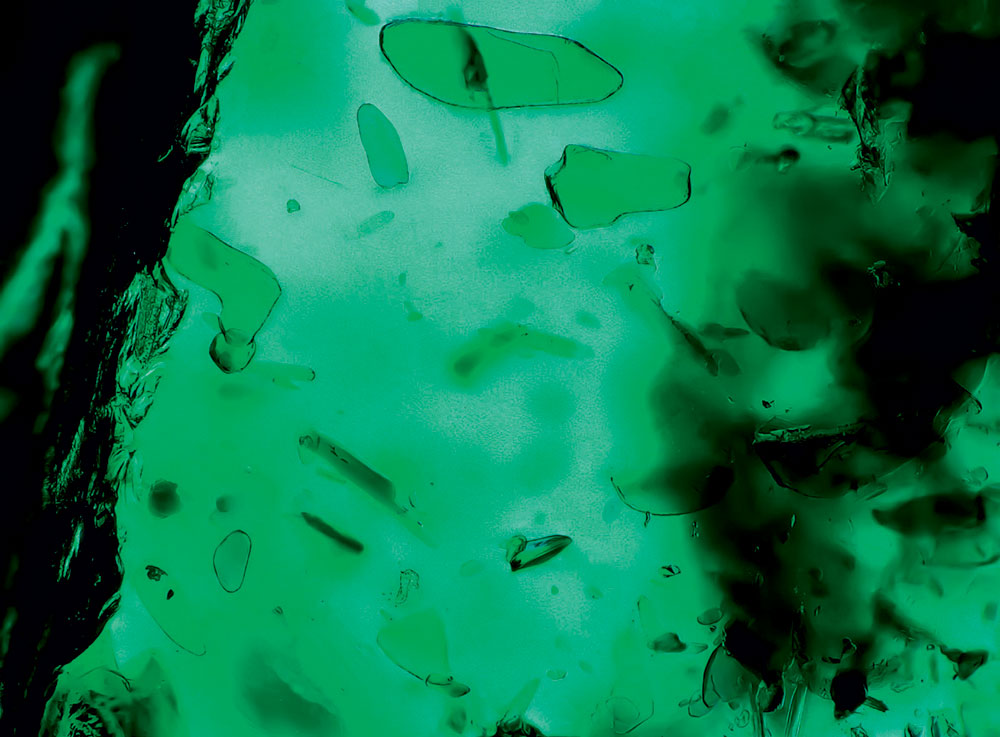
The study of solid inclusions (Figure 1) remains one of the most relevant sources of information for determining the geographic origin of gemstones. The minerals trapped or absent as inclusions within emerald crystals directly reflect the local geology and host rock characteristics of the specific deposits where they formed, varying distinctly from one location to another.
Through micro-Raman analysis of a large reference collection of emeralds, combined with an exhaustive review of the scientific literature on mineral inclusions in this gemstone, we were able to identify significant markers that support the reliable attribution of geographic origin.
Materials and Methods
All photomicrographs were acquired using a VHX 7000 digital microscope at the Bellerophon Gemlab laboratory in Bangkok, with magnifications ranging from ×30 to ×2500.
The 1628 samples were acquired either directly at the mine, or from the miner close to the mines, or in the market from trusted contacts (Table 1). Weighing between 0.17 and 43.61 carats, they included polished wafers (with two windows), rough stones, and faceted gems. UV-Vis-NIR spectra were also collected at Bellerophon Gemlab using an Ocean Insight SR-4XR250-50 spectrometer with 500 lines blazed at 250 nm, a 50 μm slit, and coupled with a 10-watt halogen and 1.2-watt xenon light source.
Raman spectra were obtained at Bellerophon Gemlab using a BWT-8400000340 i-Raman Plus 532S. For internal inclusion analysis, the system was operated in confocal mode with 20X and 50X objectives using 532-nm highly coherent lasers.


Low Iron Type and High Iron Type
Emeralds can be classified into two distinct groups: low iron type and high iron type, based on the relative presence of the Fe²⁺ absorption band at 825 nm observed in their respective UV-Vis-NIR spectra (Figure 2).
This spectral distinction, combined with the presence of specific solid inclusions, makes it possible to highlight certain geographic origins. Indeed, some inclusions are found in only one low iron deposit but may also occur in one or more high iron deposits.
Low iron deposits notably include Colombia (Muzo and Chivor), Zambia (Musakashi), and Afghanistan (Panjshir). In contrast, high iron deposits comprise a broader range of sources, including Australia (Torrington, Emmaville/Torrington, Poona), India (Jharkhand, Rajasthan), Brazil (Minas Gerais, Bahia, Goias), China (Davdar, Malipo), Ethiopia (Shakiso), Madagascar (Mananjary, Ianapera), Nigeria (Jos Plateau), Norway, Pakistan (Chitral and Swat), Russia (Malysheva), South Africa, Tanzania (Lake Manyara), Zambia (Kafubu), and Zimbabwe (Sandawana).


Classification and Distribution by Strunz Class
A total of 114 different inclusions were analyzed in emeralds from a wide range of geographic sources worldwide. An initial classification of these minerals was carried out according to the Strunz system (Table 2), which groups mineral species into ten major categories based on their chemical composition and the nature of their anionic groups.
Among the inclusions identified, silicates represent the most diverse class, with 51 different mineral species observed in emeralds, followed by oxides, sulfides, and carbonates.
In contrast, halides, borates, and native elements are the least represented classes, with only 3 and 2 minerals recorded in each of these categories.
Mineral Inclusions with Low or High Indicative Value for Geographic Origin
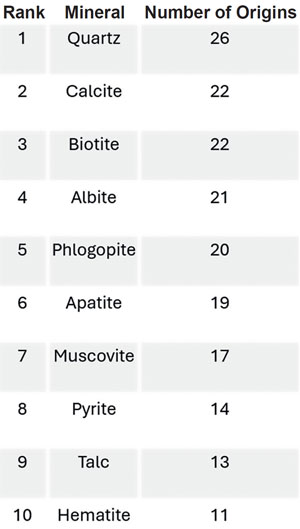
The most frequently observed solid inclusions in emeralds are quartz, followed by calcite and apatite. Table 3 presents the ten most common inclusions found in the samples analyzed.
Although their presence is not relevant for determining geographic origin, these inclusions have, to date, never been identified in synthetic emeralds, making them useful indicators for distinguishing natural from synthetic gems.
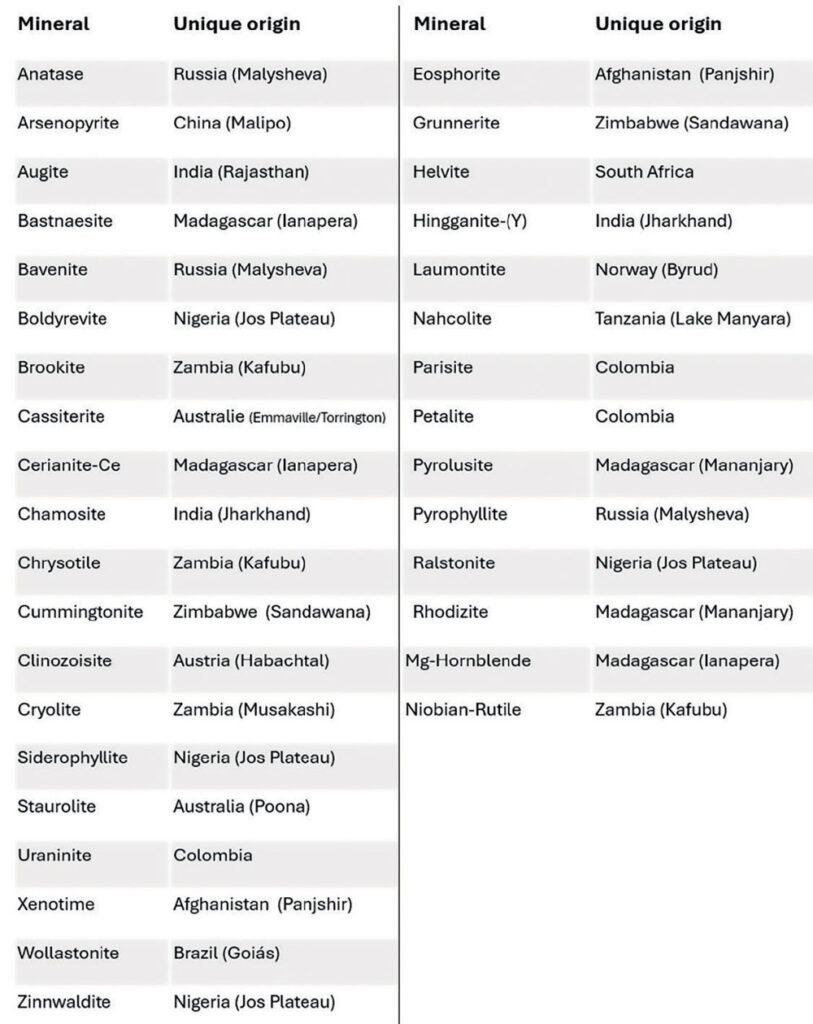
Conversely, a list of 34 minerals has been established as occurring in only a single geographic origin. These inclusions therefore serve as particularly reliable markers for origin determination (Table 4).
Determination of Emerald Geographic Origin Through Solid Inclusion Analysis and UV-Vis-NIR Spectroscopy
The differentiation between low and high iron types makes certain solid inclusions particularly useful for identifying the geographic origin of emeralds (Figure 3). For instance, baryte (BaSO₄), a barium sulfate, is found in emeralds from Colombia, Madagascar, Russia, South Africa, and Zambia (Kafubu).
Among these, only Colombia is classified as low iron, making baryte, when associated with a low iron UV-Vis-NIR spectrum, a strong indicator of Colombian origin. Similarly, galena, a lead sulfide, observed in both Colombia and South Africa, helps support origin determination through iron-type comparison.
The Davdar deposit in China exhibits fluid inclusions similar to those found in Colombian emeralds, along with a low iron UV-Vis-NIR absorption spectrum (Saeseaw et al., 2014). However, hematite (an iron oxide) and scheelite have only been identified at Davdar or in high iron localities (Schwarz and Curti, 2020). In Afghanistan, emeralds, also of the low iron type, are distinguished by the presence of rutile (a titanium oxide) and tremolite (an amphibole), two minerals otherwise found only in high-iron sources, thus reinforcing their diagnostic value.

Conclusion
The results confirm the value of combining solid inclusion identification with UV-Vis-NIR absorption spectroscopy for determining the origin of emeralds. Analysis across a wide geographic range led to the identification of 34 minerals found to be related to only one deposit, making them strong indicators of geographic origin. In contrast, minerals such as quartz, calcite, or apatite, although frequently observed, have low discriminative value due to their widespread presence across numerous deposits.
Limitations
Geographic origin determination of emeralds relies heavily on identifying inclusions, which reflect the local geology and host rock characteristics of specific deposits. However, this must be combined with trace element analysis and spectroscopic properties, since relying solely on one criterion poses significant risks of misidentification.
Further Research
Not all inclusions are identical, even when found across multiple deposits. Variations in their size, shape, and edges may provide additional criteria for distinguishing emeralds by prove-nance. Quantification of solid inclusions in these emeralds is currently under investigation.