


During the Christmas to New Year 2024/2025 period and throughout 2025, the Guild Field Expedition Team traveled to Fei Cui producing areas and market centers for A-Type sample laboratory/education reference samples and to study the state of the market.
With the samples collected in Guatemala, we were able to develop highly accurate testing procedures and a database to distinguish Burmese jadeite ─ a very important distinction in China for price point. In Kazakhstan, we were able to understand firsthand the potential volume of the deposit and the market for the material.
At Fei Cui markets in China and Myanmar as well as during our mining area field expeditions, we were able to achieve a deep understanding of the supply chain from sources to China and in China; thus, providing a detailed view into this dynamic market so closely tied to the Chinese market and culture.
Mandalay Jade Market and the Live-Streaming Phenomena
During Christmas 2024 and New Year 2025, Guild Field Gemology started the year out with a field expedition to Myanmar to study the market and collect samples. A major part of the expedition was to research the Fei Cui market in Mandalay. While the field gemologists had visited this market on numerous earlier occasions, the changes post-Covid were revolutionary.
Our trip started with the Jade Pagoda which we were lucky enough to see before the tragic earthquake destruction. The Pagoda is covered in over 11,000 tons of jade of all colors, textures, and qualities. Over 75 feet high, it was constructed between 2012 and 2015. The individual who had the determination, vision, and passion to create this pagoda had been buying and stockpiling the jade for this magnificent structure for over 25 years.

(Photo: Andrew Lucas. ©Guild Gemology Education)
Next, we visited Fei Cui cutting facilities. These were like what we have been seeing for years ─ many small cutting shops in homes converted into cottage industry cutting shops, with basic cutting, sawing, forming, and polishing equipment; not near the sophistication seen at Fei Cui manufacturing locations in China.

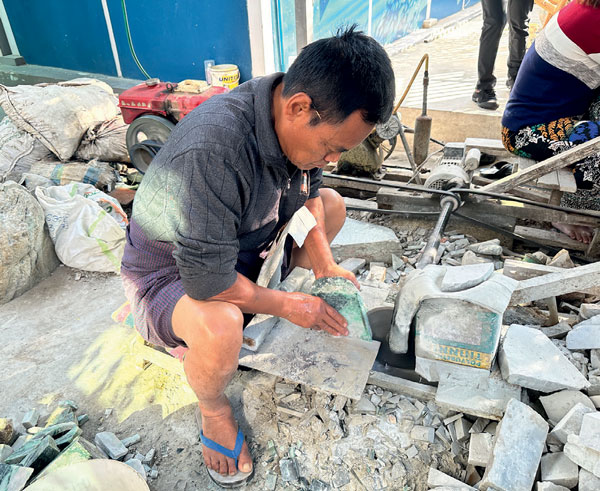
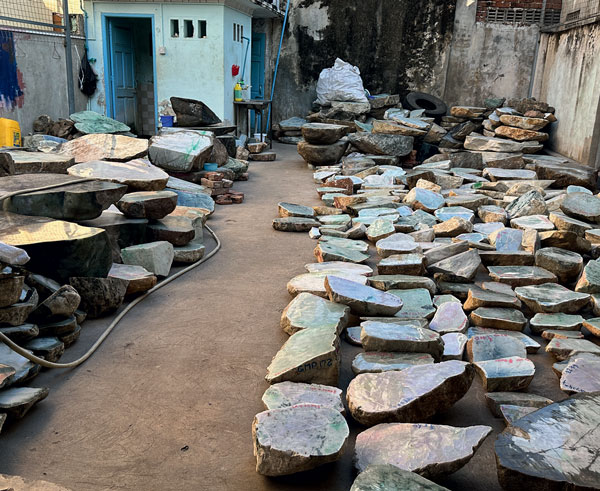

Always exciting is the sawing open of boulders and grinding windows into the boulders. This is the great gamble where money is suddenly made or lost, even for the most experienced Fei Cui buyers. We witnessed all styles of cuts, including bangle bracelets, rings, saddle rings, cabochons, beads, drops, pendants, carvings, etc.
One of my favorite aspects is to watch Fei Cui cutting experts decide how many bangle bracelets to cut from a sawn boulder and how to place them for the most efficient use of color zoning in order to maximize value.
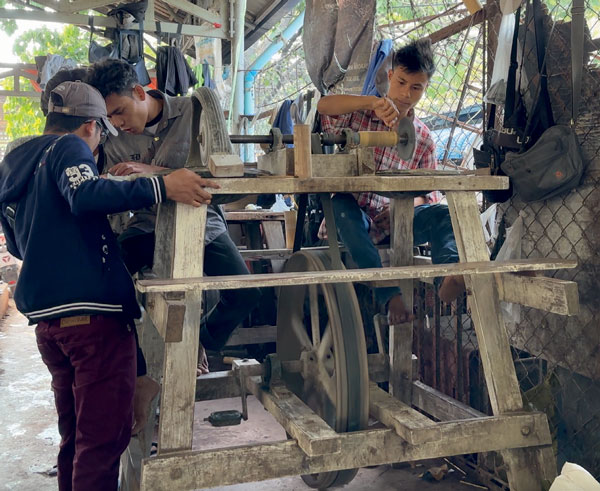
powered cutting wheels. (Photo: Andrew Lucas.
©Guild Gemology Education)
(Photo: Andrew Lucas. ©Guild Gemology Education)
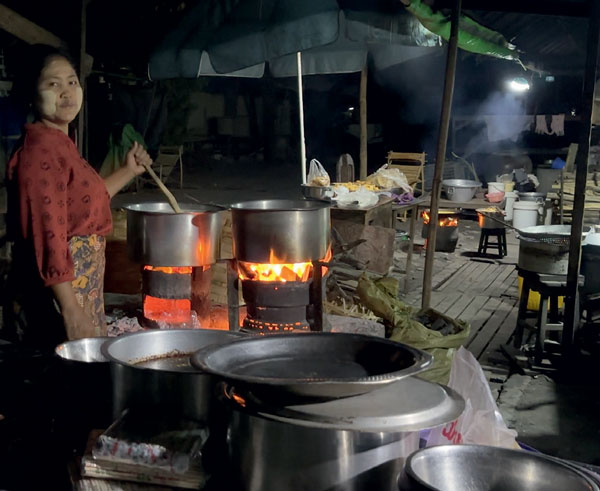
Besides the home-converted cutting shops, there are also cutting facilities and free-standing cutters right inside the Mandalay Jade Market, where a tiny fee will get you through the chain link fence and into the most exciting Fei Cui market in the world. There, the cutting was like that of the outside cutting shops ─ same equipment and cutting techniques, and processes.
We watched the critical decisions of sawing and where to place the cuts. Some of the cutting apparatuses in the Jade Market were the very traditional foot-powered wheels, allowing for total human control.
(Photo: Andrew Lucas. ©Guild Gemology Education)
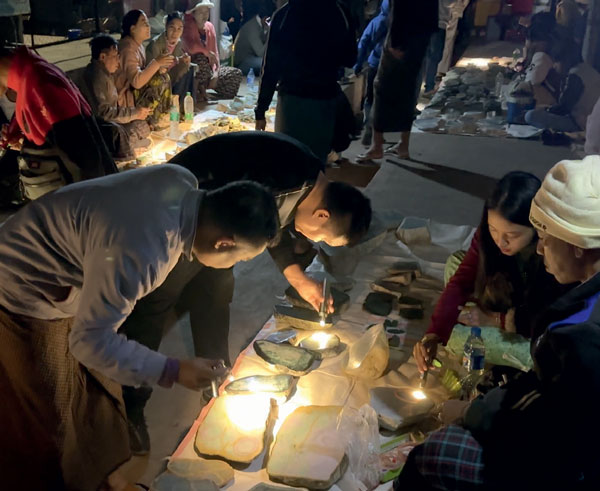

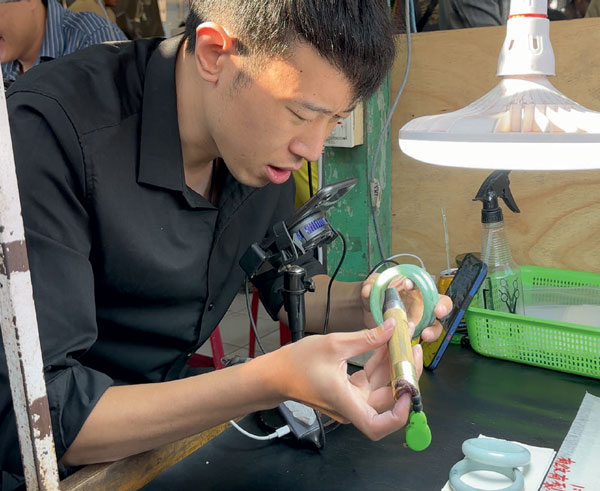
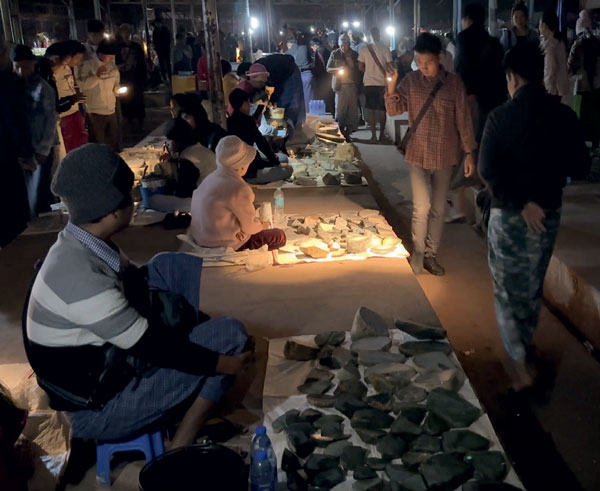
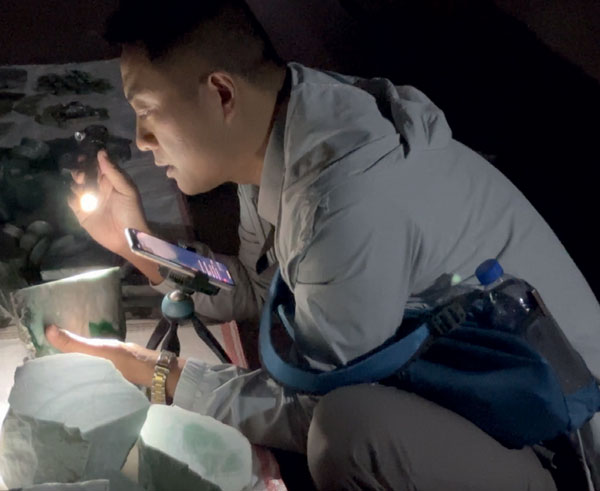
We started our Jade Market research at the early morning rough market just outside the gated market before sunrise. Rough buyers prefer to examine rough almost in the dark with a few overhead lights and a torch that they will continually tap on the boulder or sawn piece of Fei Cui to get an idea of quality.
It was quite amazing to see this highly complicated determination performed almost in the dark. What was even more amazing was to see rough buyers in the dark examine the rough with their flashlights and then live-stream the images back to China using their cell phone where their customers would make their buying and pricing decisions based on what they saw on their cell phone screens. We were totally amazed.
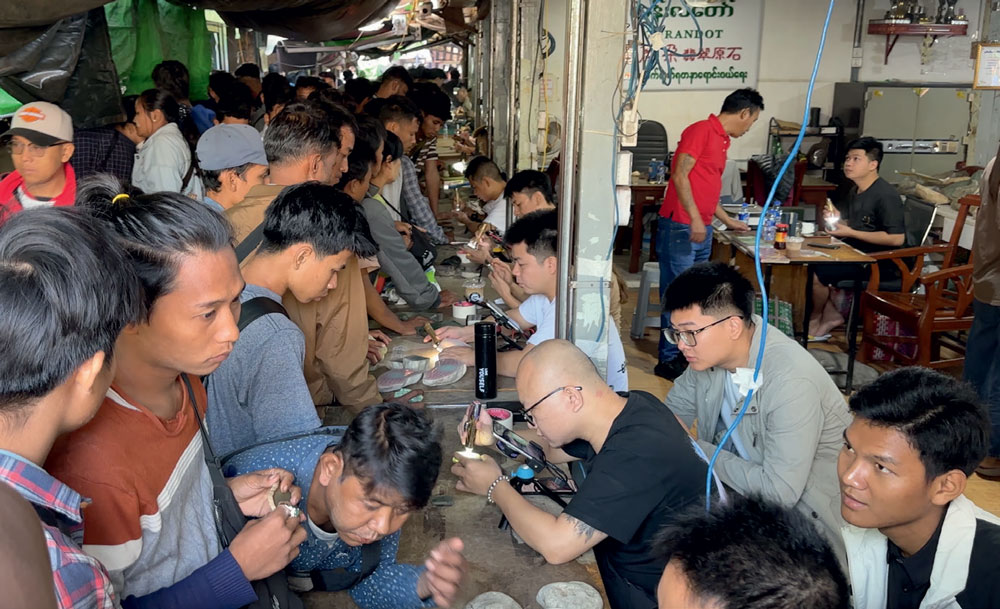
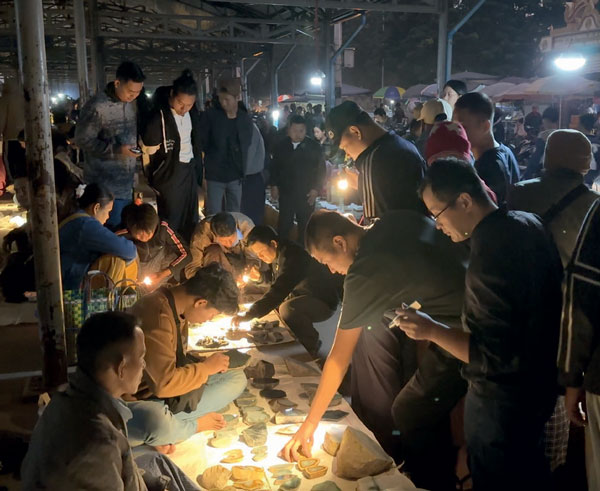
The most amazing aspect of our Mandalay Fei Cui research was yet to come. After sunrise, we entered the gated market and saw what I would consider now the most intense gem market in the world.
While I have been to this market in the past, it was now nothing like before. Packed shoulder to shoulder like canned sardines, Burmese dealers interacted with an endless sea of Chinese live-streamers selling Fei Cui back to China with their cell phones. Some Chinese live-streamers were selling rough and other finished Fei Cui in a variety of styles, sizes, colors, and qualities. Some sold wholesale to Chinese dealers in China and while others went direct to Chinese consumers. The dealing, negotiation, and selling over live-streaming was some of the most exciting and intense trading I have ever seen. Groups of Burmese dealers would surround each Chinese live-streamer and push their Fei Cui to them, immediately engaging in fast and furious negotiation. The Chinese live-streamer would show it to their customers by phone and the intense three-way negotiating would get underway.
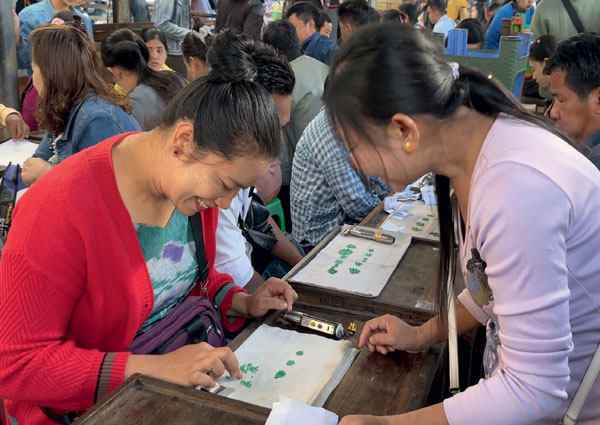
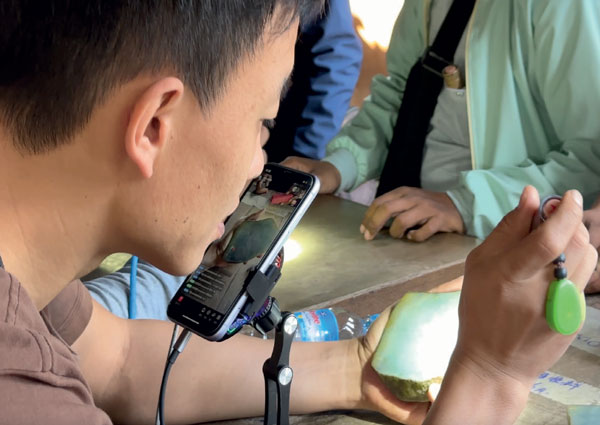
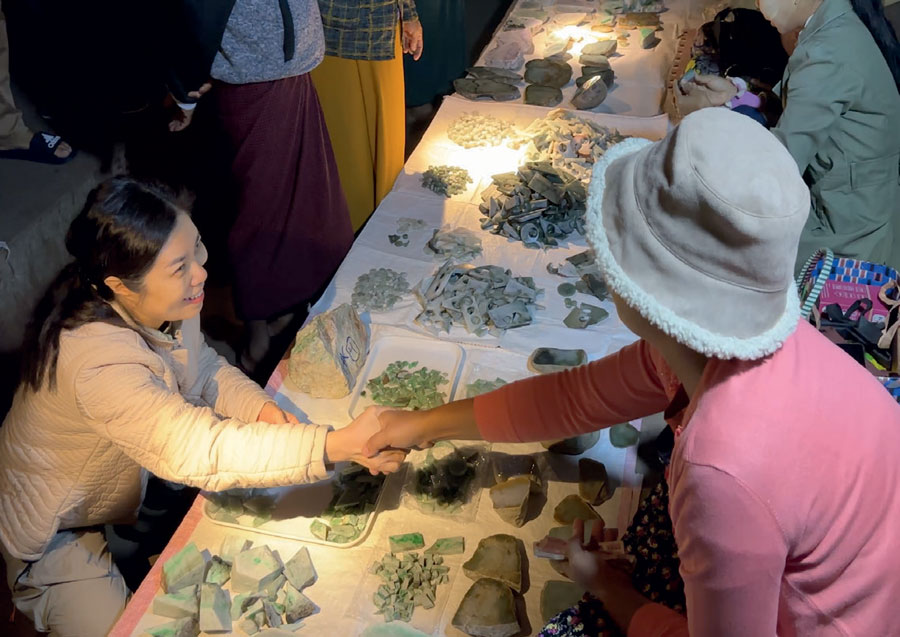
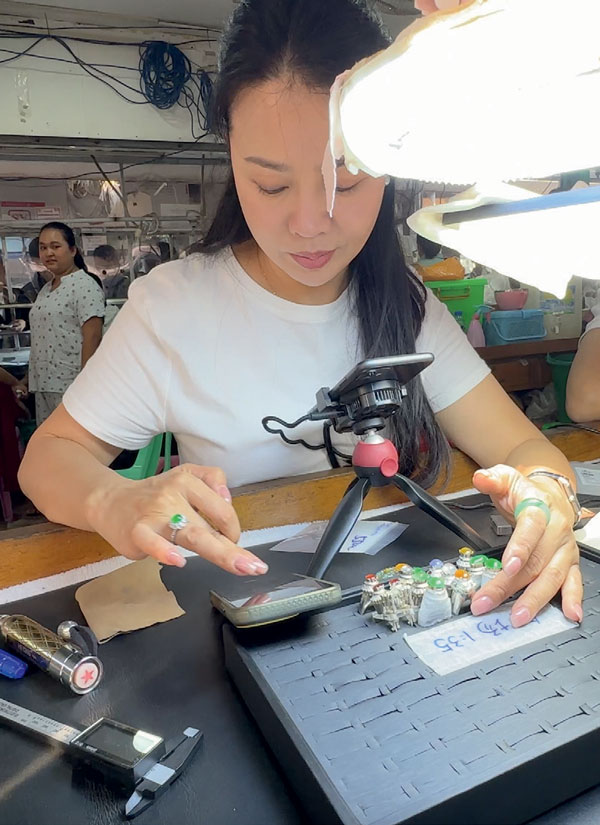
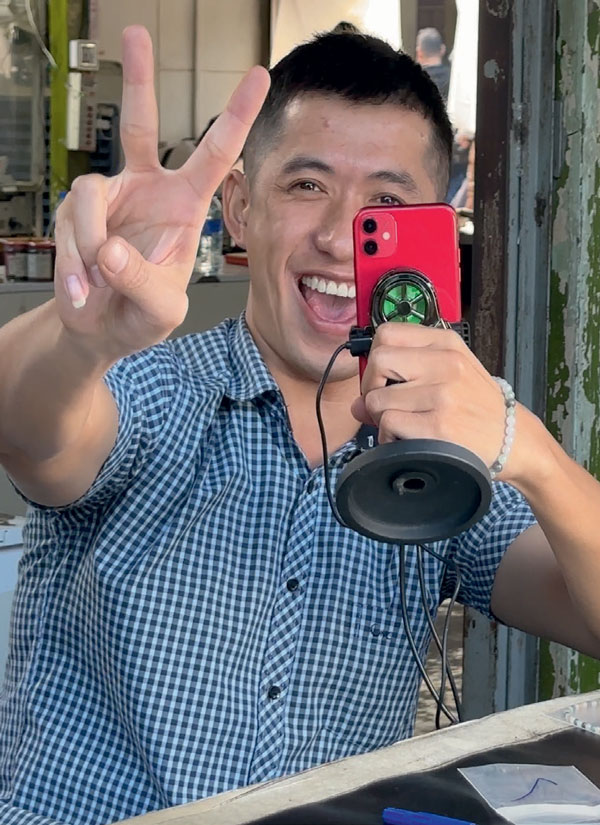
This form of Chinese live-streaming from the source goes on in Sri Lanka, Thailand, Pakistan, Vietnam, Indonesia, Zambia, and other source countries but I have not seen the scale and intensity as that in the Mandalay Jade Market. While the terrible earthquake interrupted the market, the Chinese live-streaming phenomena is already coming back to Mandalay.
Guatemala ─ Mines and Production
Right after the 2025 Tucson Gem Show, Guild Field Gemology traveled to Guatemala to research Fei Cui mining and collect A-Type samples for country-of-origin determination. Guatemala has become an important source of Fei Cui for China and the international market.
The price difference for Burmese and Guatemalan Fei Cui of the same size and quality can be extreme, so country-of-origin determination is critical for the market. Also, very little accurate information has been available for Guatemalan mining and production. So, following our motto at Guild “If you don’t go, you don’t know,” Guatemala was a source of high importance to Guild Field Gemology for the laboratory and education.
Only the Ancient civilizations of Mesoamerica tie a gem into their culture as the Chinese have done for Fei Cui and, interestingly, it is the same gem. The Olmecs were aware of and priced Fei Cu,i followed by the Mayans. The Mesoamerican civilizations had cultural, ceremonial, religious, spiritual, and afterlife connection with Fei Cui. Believed to aid fertility in agriculture and people, ceremonial connections, symbols of wealth and power, and a bridge to the afterlife, the Great civilizations of Mesoamerica prized Fei Cui as one of the most valuable materials. As we have lectured throughout China about our Fei Cui field expeditions, this has been one of the most fascinating aspects for the audiences.
We stopped in Antigua, Guatemala to see the tourist market for Guatemalan Fei Cui. Many of the items being sold were local reproductions of Olmec, Mayan, and Aztec Fei Cui objects from Antiquity, along with contemporary jewelry. These stores were very popular with tourists, especially Americans and Europeans from cruise ships, which would come in groups.
The mining area in northeastern Guatemala near Morales and Zacapa (exact locations under confidentiality agreement) consisted of several small-scale to medium-scale operations primarily open-cast mining. Some of these mines are on hills above the river where alluvial Fei Cui has been found. The open-pit mining has been going deeper with some mines over the last few years digging from five meters to now over thirty meters deep. The deposits are in-situ, and the operations are mechanized. Once excavators and trucks remove material and expose in-situ Fei Cui, the material is cut out of the host rock.
At one miner’s home in Morales, we examined ten tons of freshly mined Fei Cui in a variety of colors including the well-known Olmec blue, the predominate color of Guatemalan Fei Cui, as well as black, green, and a small percentage of vivid Imperial green color with an Icy Texture.
Near Zacapa, we visited a large licensed mining area with black Fei Cui, blue Fei Cui, and green Fei Cui in-situ productions. Some of the boulders produced were very large. Eddie, the mine owner, had self-taught himself the formation gemology to an amazing degree and showed us the serpentine and other rock associations at his mine.
Eddie was also able to provide accurate export figures by quantity and color for Guatemalan Fei Cui. Much of the material went to China for manufacturing and is exported in shipping containers.
Exports by weight in tons
In 2020 ─ 400 tons; in 2021 ─ 700 tons; in 2022 ─ 1,800 tons; in 2023 ─ 2,500 tons; and in 2024 ─ 2,800 tons.
Exports by color
Blue 70%; Black 25%; Green 5%; Imperial Green, less than 5% of Green; Purple 0.1%.
Also, near Zacapa, we searched the riverbanks for alluvial river jade with the so-called bloodhound ─ a man famous in Guatemala mining for finding Fei Cui.
While there, we learned from Eddie to use a rock hammer to tap and listen to the rocks to find Fei Cui along the river. A small number of Chinese buyers, concentrated in Morales, buy Guatemalan Fei Cui for export to China. While tourists also buy locally manufactured jewelry and objects, especially in Antigua, there is also a growing domestic consumption of Guatemalan Fei Cui in lower price point material, even treated B+C Fei Cui.
The expedition to Guatemala enabled us to get an accurate account of Fei Cui mining and production and kilos of A-Type samples for our laboratory research and education.
Kazakhstan ─ The Mine and the Products
Kazakhstan is the ninth largest country in the world and the largest landlocked country. It is roughly the size of Western Europe but with only a population of approximately 19.5 million people. Kazakhstan translates into land of wanderers. Kazakh comes from the ancient Turkic word qaz meaning to wander. The name Cossack (warrior group of free farmer-horsemen evolving around 3,000 years ago) has the same origin.
The country is part of the Eurasian Steppe, which is the largest grassland in the world and extends from Hungary to China, almost one-fifth the way around the world. Due to this large extent of flatlands, the use of horses for battle may have been developed by the nomadic people there. The historic Silk Road passes through Kazakhstan. Ninety-nine elements on the Periodic Table are found in the country. It is the world’s largest uranium producer and significant producer of oil, natural gas, coal, copper, and gold.
Our expedition to the Fei Cui mine in Kazakhstan during summer 2025 began with a flight from China to Almaty (largest population city in Kazakhstan), as we watched stunning snowcapped mountains below when crossing the border. The Fei Cui mine is about six to eight hours drive from Almaty near the large Lake Balkhash, one of the largest lakes in Asia. It is half saline and half freshwater. The Steppes live up to their reputation, as we saw nothing but grassland the entire drive.
The Fei Cui mine was discovered by the Soviet Union in the 1950s and had been previously mined by the Russians and then a private company. Today, a new company (Jade Vault is one of the corporations involved) is taking over where others left off. They are coming into a mine fully ready to be exploited. The mine itself is a large open-pit operation.
The climate at the mining area has extreme fluctuations of temperatures in summer and winter ranging from plus 50○C to minus 40○C.
The Soviets cut the open-cast mine to follow the Fei Cui deposit. What is extremely fascinating is the two massive monoliths (large single rocks) that rise dramatically from the open pit. The monoliths are part of the Fei Cui ore body that runs the length of the pit. The water in the pit is groundwater that is above part of the Fei Cui ore body.
The mining plan is to start mining the two monoliths down to the ore body and then continue to mine the ore body. They will have to create benches to hold back the groundwater once they start to mine the ore body after they mine out the monoliths.
To mine the monoliths, they will use hydraulic hammers and possibly rock spreaders to break the rock apart, followed by diamond-bit saw wires to remove the Fei Cui sections. The monoliths have a very dry appearance on the outside and numerous cracks running through the material. The owners are hoping higher quality material may exist inside the monoliths.
While we were there, they were not mining but focused on the obvious first step. When you are at the mine site, you can almost look in any direction and literally see thousands of tons of Fei Cui boulders that have already been mined and are just sitting there.
They had just shipped 300 tons of boulders to China for evaluation and manufacturing into finished products and planned to ship another 1,000 tons the next month. At the time of our visit, they were grading the boulders with the renowned Chinese Fei Cui expert, Professor Wong Leesheng, who was part of our expedition.
The material was predominately commercial quality with the majority intended for ornamental use and some percentage for commercial quality jewelry, especially bangle bracelets.
Most of the boulders were a light gray color with green areas of color zoning that ranged from light to dark green. Some material was predominately green color, and we saw some intense green, but we did not find vivid Imperial Green.
Core samples from the monoliths revealed gray and various tones of green color-zoned material that had a coarse grain structure, with some having a tighter grain structure suitable for commercial jewelry. It is reported that the Russians removed some vivid green better-quality material.
The owners are hoping to produce significant amounts of attractive light gray with green color zoning to predominately green material for commercial quality jewelry, although this quality will not be the majority of production. Pendants, rings, beads, and carvings will all be produced with perhaps bangles making up most of the jewelry product.
Much of the production is planned for ornamental carvings, traditional style Chinese bowels, vases, chopsticks etc., plus luxury household items such as tile, tabletops, doorknobs, and more for Chinese and Western markets.
We brought back kilos of A-Type research samples and will be studying them for country-of-origin determination as well as watching the production of product from the material shipped to Guangzhou.
Kunming Fei Cui, Stone, and Gem Show
Author Ruby Liu and I gave a Fei Cui Field Research presentation at the June Kunming Fei Cui, Stone, and Gem Show. This is a great show that focuses on Fei Cui and other stone and aggregate materials, as well as a variety of art, wood, ceramic, furniture, and even tea.
Kunming is a wonderful city in China’s Yunnan Province and has a reputation as Eternal Spring. They have many ethnic groups with a variety of colorful clothing, great music and dancing, and an incredible variety of cuisine, as well as fun local customs. The people here seem to really enjoy life and are very happy.
The show had quantities of fine quality Fei Cui in Imperial Green, Intense Green, Vivid Lavender, beautiful color zoning and Icy Texture and nephrite in beautiful white as well as color zoned. There were also magnificent large carvings representing classical Chinese scenes and cultural symbolism.
A variety of material was at the show. African Fei Cui is an aggregate quartz material first reported to be from China and later revealed to be most likely from South Africa. It is attractive and near colorless with green zoning semi-transparent material. At a very low price point, it is taking the Chinese market by storm.
Landscape agate in fine quality texture and artistic scenes is held to be very valuable in the Chinese market. I especially enjoyed the natural gem paintings. These are from material like marble where slices are taken from large material and when the slice is orientated correctly a magnificent scene may appear like a goddess ascending to the heavens or even a dragon.
Ruili ─ The Chinese/Myanmar Border Connection
Ruili is a vital part of the Fei Cui supply chain to China as it is positioned right at the Myanmar border. It is a manufacturing and trading center with Burmese Fei Cui coming across the border. Our first stop was at the border where there were numerous Fei Cui dealers selling rough.
I discussed one boulder with a dealer who had bangle bracelet outlines drawn on the boulder and his opinion of the yield of bangle bracelets from the boulder. If you buy the boulder, he could offer cutting services. This was a common business model at the border.
Next, we visited a large manufacturing and trading center where there was a plentiful supply of Burmese rough jadeite ─ mainly sawn boulders with bangle outlines and saddle ring outlines drawn on them, expertly utilizing the shape and yield while incorporating the color zoning for maximum value. Some bangles included three colors such as white, green, and lavender. Others used two colors and gave great consideration as to how to incorporate the green zoning.
Among all the amazing rough jadeite was one piece that was incredible, a once-in-a-lifetime find. A small boulder that had a window polished in it to reveal magnificent very highly vivid Imperial Green color with a high Icy Texture, just glowing vivid green.
Also, Ruili had finished Fei Cui stores with fine color inventory. There was even a night rough market that had a small number of dealers and amount of inventory with a few live-streamers while we were there.
We were told that the industry moved to Mandalay. After the earthquake, the rough dealers and live-streamers returned to Ruili but at the time of our visit in June they had already gone back to Mandalay.
While in Ruili, we visited the Wanding Border Culture Park Museum and were given a tour by Mr. Yang Zixiang the founder of the museum and a legendary figure in the Chinese Fei Cui industry.
The museum was quite amazing with a large part dedicated to the WWII efforts at the Chinese border with Burma and in Burma, including the lifeline supply chain to Burma.
Many war-related historical items were on display including restored original U.S. military Willy’s Jeeps that Mr. Zixiang and I shared a passion for. [As a teenager I had a rebuilt and customized Willy’s Jeep that I spent many hours driving through the Arizona desert and mountains]
As we went through the gemstone section I noticed a gem painting from Myanmar depicting the Burmese King and a French dignitary as the King showed him the legendary Nga Mauk ruby and asked him the price. As I talked about the story, Mr. Zixiang was thrilled that someone else knew the story and could talk with him about it.
After returning to my office in Shenzhen, to my great surprise, the gem painting was waiting for me! Mr. Zixiang had bought two paintings in Mogok and sent me one. It is now in one of our classrooms and every ruby and sapphire class hears the story. Another amazing friendship made through Field Gemology.
Fei Cui Gemology: Country of Origin, Grading, Standards, Trade Terms
For several years, we have been documenting and researching Fei Cui samples from around the world as well as working with the industry for color and quality grading standards and terminology. This has led to country-of-origin determinations as well as grading, standards, and terminology.
Our LA-ICP-MS study of A-Type samples has proven invaluable for conclusive country-of-origin Fei Cui identification as well as inclusion studies. Guild will continue to build a massive database for Fei Cui identification as well as precise standards for color grading and quality grading.
Summary
The only jewelry category larger than Fei Cui in China is gold. Fei Cui is a larger market than diamond, pearl, or colored gemstones. It is a jewelry category that transcends the material and ties directly into culture; a material that is of great mystery to the West in terms of understanding the cultural connection and how to look at, appreciate, and evaluate it; a material that has perhaps no equal in terms of gem and culture ─ not just for the Chinese but for the ancient Olmec and Mayan civilizations of Mesoamerica.
As opaque to the West as the material, is the market and supply chain. Indeed, even in China the current sources, supply chain, and market are evolving. The importance of Guatemala as a country of origin and the supply from Myanmar are changing dynamics, as is the great fascination for the role of Chinese live-streamers, both in Myanmar and in China.
Even the successful promotion outside of China by Gemporia for Guatemalan jade (manufactured into products in Guangdong Province, China) to be sold in Europe is an important trend to follow.
- InColor
- InColor

- InColor
- InColor