


As its title implies, this book presents a detailed, scholarly, and engaging journey through the long, intricate history of gemstone cutting—a craft that sits at the intersection of artistry, geometry, gemology, and human ingenuity.
From its opening chapters, the authors demonstrate a deep command of the subject, weaving together archaeological evidence, historical accounts and drawings, as well as technological details and advances to show how humans have transformed rough minerals into objects of beauty and value.
Among the book’s main strengths is its chronological clarity. The early chapters explore the rudimentary polishing techniques of ancient civilizations, revealing how limited tools produced enduringly elegant forms. As the narrative moves into the Middle Ages and Renaissance, the authors highlight the innovations that accompanied the development of better abrasives and more precise cutting instruments. These sections are particularly vivid with diagrams and illustrations to help the reader visualize the evolution from simple cabochons to the earliest faceted stones to the designs still in use today.
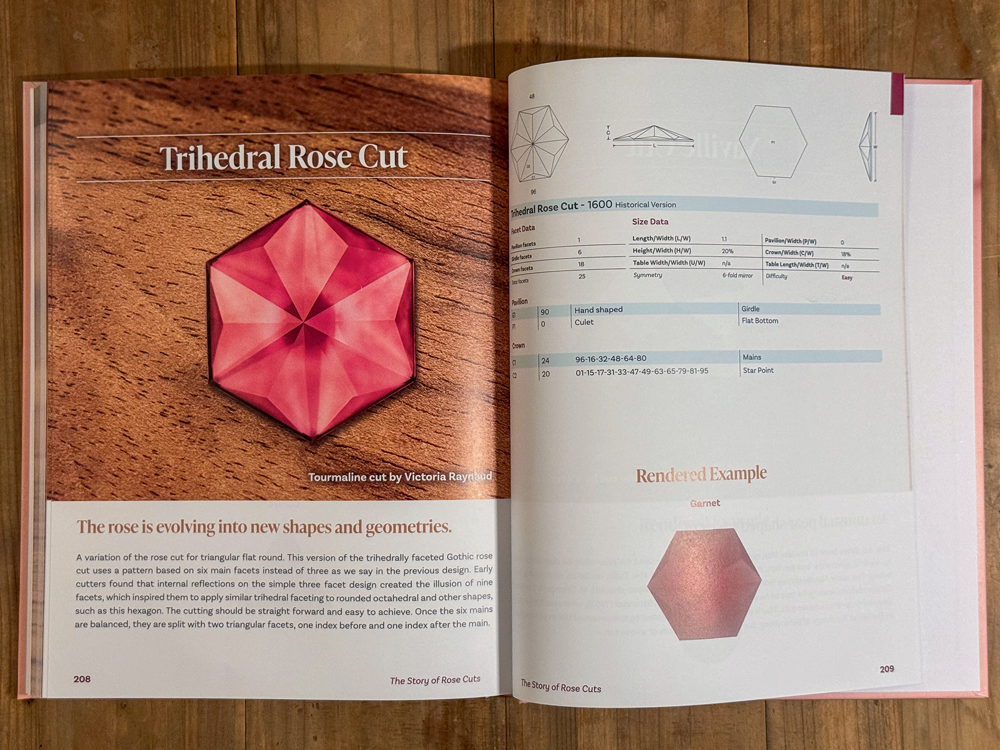
For aficionados and/or students, the authors provide detailed instructions and information—pavilions, size, facets, etc.—on fifty antique designs, thus making these historic cuts accessible to gemcutters today. They also provide beautiful photos of the actual historic cuts and modernized versions of the same cut.
As stated in the book’s beginning, the authors strived to make the designs as simple and easy to use as possible… [The designs] have been compiled from photos, drawings, notes, museum collections, and more, and then adapted into 21st century faceting diagrams… Many of the designs have been forgotten today, but all of them have something to teach us.
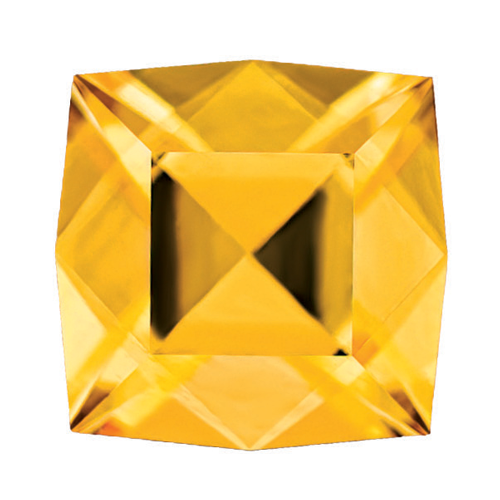
These two pages describing the Cheapside Trap Cut, along with its detailed cutting data, are representative of the type of information and images offered in the book. For this particular cut, the authors describe it as follows: This design comes from the Cheapside Hoard from 17th century London. It is one of the simpler designs for colored stones that we see represented in the Hoard. In this pattern, we can clearly see the evolution from the Table Cut with only four facets and a table on the crown to something more creative and complex. Adding four corner facets introduces triangular elements and yields a lozenge-shaped table. This produces a softer more elegant look than the blocky, rigid Table Cut and paves the way for the fuller brilliant pattern later refined in the subtly different French Cut.
Below are a few examples of the historical cuts and diagrams in the book.


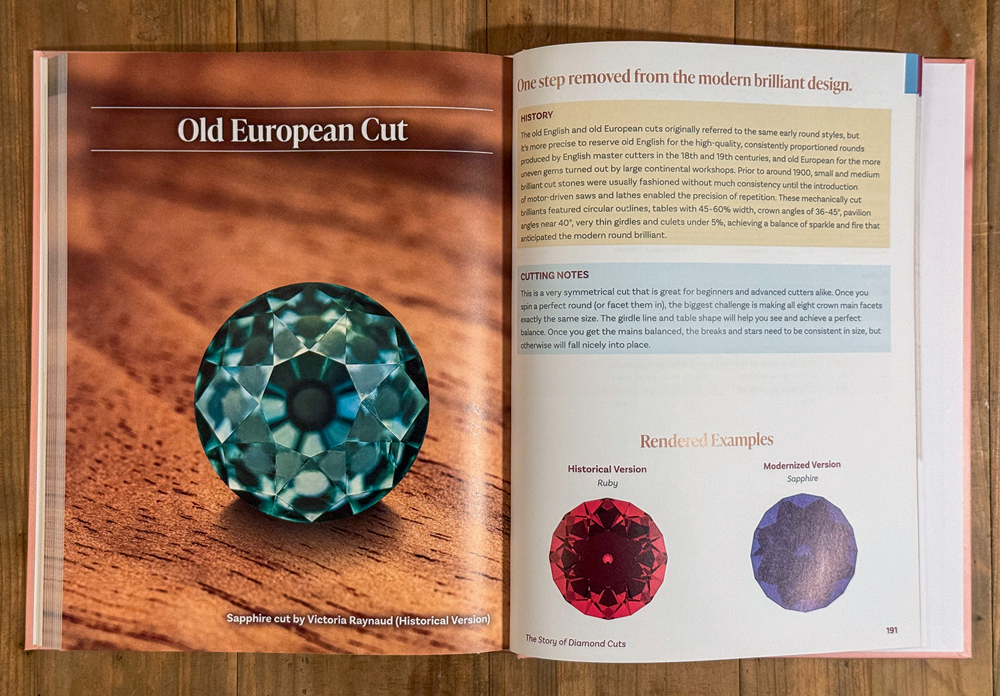
Skipping ahead a century or so, and many examples in between, is an interesting discussion—along with suggestions to prospective cutters, of the Old European Cut, which the authors describe as a very symmetrical cut that is great for beginners and advanced cutters alike. Once you spin a perfect round (or facet them in), the biggest challenge is making all eight crown main facets exactly the same size. The girdle line and table shape will help you see and achieve a perfect balance. Once you get the mains balanced, the breaks and stars need to be consistent in size, but otherwise will fall nicely into place.
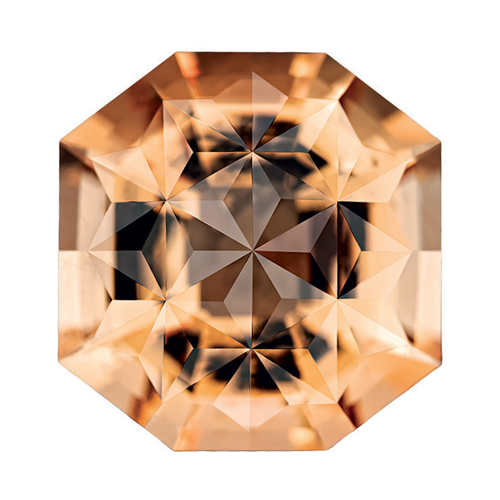
The last section describes the story of Rose Cuts, starting with the Early Flower Cut, one of the earliest faceted designs offered in the book, with its design dating back to Roman times. The narrative follows the evolution of this cut into various shapes and number of facets and concludes with the pear shape, originally documented in 1594, with an example from the early 20th century. The example shown below is the Trihedral Rose Cut, described as a variation of the rose cut for triangular flat round… Early cutters found that internal reflections on the simple three facet design created the illusion of nine facets, which inspired them to apply similar trihedral faceting to rounded octahedral and other shapes, such as the hexagon.
The Historic Teachings of Gemcutting is important not only as a historical survey but also as a celebration of an enduring art. It offers depth without dryness, technical insight without alienation, and a compelling vision of gemcutting as a craft shaped by culture, science, and the timeless human pursuit of beauty.
Whether one reads it out of academic interest, artistic curiosity, or a simple fascination with sparkling gemstones, this book leaves a lasting appreciation for the people and ideas that shaped this remarkable tradition.
All images are courtesy of Justin K Prim and Victoria Raynaud.

- Cynthia Unninayar

- Cynthia Unninayar
- Cynthia Unninayar

- Cynthia Unninayar