

Many in the trade may have already heard about the Laboratory Manual Harmonisation Committee (LMHC), founded 25 years ago as an essential group of laboratories focused on establishing and maintaining a unified vocabulary for gemological reporting and to discuss and cooperate on gemological issues relevant to the trade.
With this article, we would like to give more insight into the history of this working group and, more importantly, our publicly accessible Information Sheets and our most recent advancements in harmonization of nomenclature and report wording that was achieved at our latest meeting in 2025 in Basel, Switzerland.
The History and Structure of the LMHC
The LMHC was formed as a direct response to the global market’s demand for consistent reporting standards. The precursors to the LMHC were the InterGemLab Group (1986) and discussions within the GILC (Gemstone Industry & Laboratory Conference of the ICA).
The decisive move to establish the LMHC occurred after a GILC meeting in Basel in May of 2001. Kenneth Scarratt was asked by Roland Naftule and Ronny Totah to form and chair a new group of international gemological laboratories to harmonize report nomenclature.
The GILC meeting had requested this formation, specifying that the new group should be (1) exclusively composed of lab representatives, (2) with a limited number of members, and (3) working in laboratories operating on the international market.
The initial members in 2001 included Gübelin Gem Lab, GIA Gemological Institute of America, CISGEM Laboratory from Italy, SSEF Swiss Gemmological Institute, and AGTA Gemological Testing Center (GTC). The Gemmological Association of All Japan GAAJ-ZENHOKYO, and GIT Thailand joined shortly thereafter.
Today, the LMHC is comprised of representatives from seven major international gemological laboratories: the Central Gem Laboratory (CGL, Japan), CISGEM Laboratory (Italy), DSEF German Gem Lab (Germany), GIA Gem Laboratory (USA), The Gem and Jewelry Institute of Thailand (GIT, Thailand), Gübelin Gem Lab Ltd. (Switzerland), and Swiss Gemmological Institute—SSEF (Switzerland).
The LMHC strictly maintains its independence, as it does not maintain formal relationships with special interest groups or trade organizations. The committee regularly meets to discuss gemological issues and to update or add to the contents of the Information Sheets.
LMHC Standardization Activities: Information Sheets
The LMHC focuses its standardization efforts on its Information Sheets (IS), which mandate specific language for reports on complex materials and treatments.
Until today, the LMHC has published on its website (www.lmhc-gemmology.org) a total of 17 Information Sheets, most concerning report language for colored stones, one for pearls, and a general one about gemological reports. This effort is designed to create a general understanding and philosophy for proper nomenclature and disclosure for gem laboratories and to suggest “preferable” language to be used in the gemstone and pearl trade.


LMHC Information Sheet, in Short
0: Gemmological Laboratory Reports. This Information Sheet provides essential overarching guidance regarding the content and legal claims of gemological reports.
1: Corundum with Residues from the Heating Process. It standardizes the nomenclature used to describe heat treatment in corundum where a degree of healing along fissures has occurred and residues from the heating process remain within healed fissures and cavities.
2: Corundum – Lattice diffusion of foreign elements other than hydrogen. This document standardizes the nomenclature for corundum that shows indications of heating accompanied by diffusion of a chemical element(s) from an external source to modify or create color.
3: Corundum with Glass-Filled Fissures and Cavities. This Sheet standardizes the nomenclature for corundum where the clarity has been enhanced/modified by the filling of fissures and/or cavities with glass. This treatment usually applies to low quality stones.
4: Corundum – Padparadscha sapphire. It defines a padparadscha sapphire as a variety of corundum from any geographical origin whose overall color appearance is a subtle mixture of pinkish orange to orangey pink with pastel tones and low to medium saturation when viewed in standard daylight. For any corundum of padparadscha-like color, a color stability test is mandatory (see Information Sheet No. 16).
5: Emerald. This Sheet standardizes nomenclature for emerald, defined as a beryl mainly colored by chromium and/or vanadium showing medium to strong green saturation. It provides standardized report wording for fissure filling and cavity filling using colorless to near-colorless oils, resins, or wax.
6: Paraiba Tourmaline. It defines Paraíba tourmaline as a blue, bluish green to greenish blue, green, or yellowish green tourmaline, mainly colored due to the presence of copper (Cu) and manganese (Mn) of whatever geographical origin.
7: Corundum – No indications of heating / Indications of heating. This Sheet standardizes the reporting of corundum that shows “no indications of heating (NH).”
8: Gemstones Where Color Authenticity is Undeter-mined. It addresses gemstones that are commonly heated and/or irradiated, but where treatment is typically not determinable, and how this should be addressed on reports.
9: Description of Color-Change in Gemstones. It standardizes the definition of color-change (main hue in standardized daylight differs from that in standard incandescent light). Alexandrite is defined as a chromium-bearing variety of chrysoberyl showing a color-change, typically from a “cold” hue (e.g., greenish) in daylight to a “warm” hue (e.g., reddish-purplish) in incandescent light.
10: Amber and Copal. This Sheet standardizes the nomenclature for natural fossilised resin (amber) and sub-fossilised resin (copal) showing indications of heating, with or without pressure.
11: Jade and Related Materials. This updated Sheet clarifies that Jade is a trade name that encompasses aggregates primarily composed of nephrite, jadeite, omphacite, or kosmochlor. The sheet includes a definition for Fei Cui, a historic Chinese name for a structurally tough ornamental aggregate composed solely or principally of any combination of jadeite, omphacite, and kosmochlor. It standardizes the classifi-cation of treated pyroxene jades using trade terms like ‘A-jade’ (no impregnation), ‘B-jade’ (bleached and impregnated), ‘C-jade’ (dyed), and ‘B+C-jade’ (dyed and impregnated).
12: Organic Fillers (Oil, Resin, Wax) in Gemstones. This Sheet standardizes nomenclature for the use of colorless or near colorless organic fillers (oil, resin, wax) in fissures, fractures, and/or cavities of any gemstone.
13: Hydrophane Opal. This Sheet defines hydrophane opal as opal that absorbs liquids to the point of affecting its appearance and potentially its weight due to considerable porosity.
14: Cobalt Spinel. This new Information Sheet stan-dardizes nomenclature for blue spinel containing traces of cobalt.
15: Tanzanite. This new Information Sheet standard-izes terminology for Tanzanite, defining it as the vanadium-bearing blue to purple color variety of the mineral zoisite.
16: Color Stability Testing of Gemstones. This new Information Sheet standardizes the method used to test the color stability of gemstones.
And finally,
Pearl Information Sheet #1: Submissions Containing Multiple Natural and/or Cultured Pearls. This Sheet standardizes the examination policies and the report wording to describe natural and cultured pearls when strung in strands, necklaces, bunches, or lots.


Updates and New Information Sheets in 2025
At the latest meeting of the LMHC working group in Basel in May 2025, significant progress was achieved and new Information Sheets (IS#14 – #16) and updates on existing Information Sheets were drafted and finally approved in October 2025 by all LMHC group members.
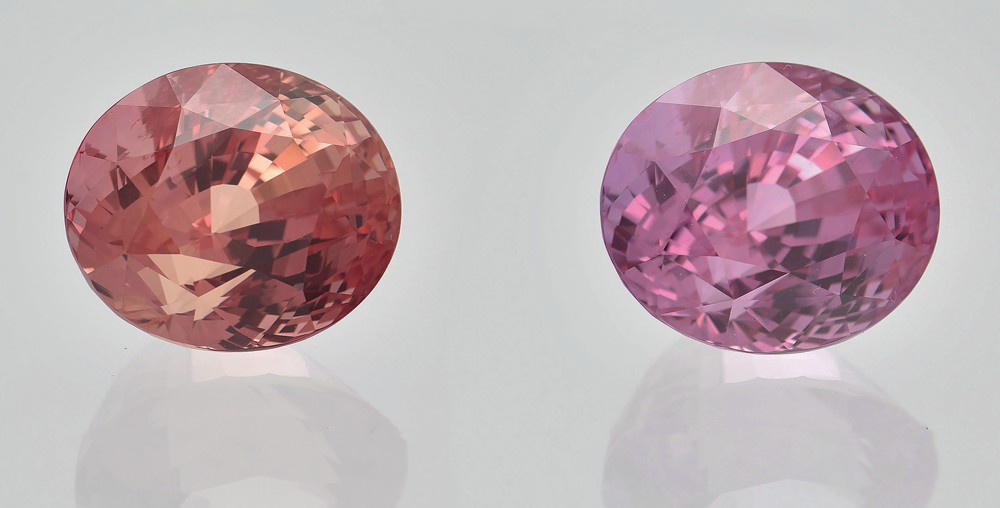
The most important topic of discussion and harmoniza-tion was about the color stability testing of gemstones (see new IS#16). The new information sheet stan-dardizes the method used to test the color stability of gemstones. It addresses issues where certain color centers are unstable, potentially resulting in the fading or shifting of a gemstone’s color following prolonged exposure to daylight. This phenomenon is specifically observed in certain padparadscha sapphires, fancy sapphires, spodumene, sodalite, or zircon.
The harmonized testing method involves three main steps: (1) careful initial color grading, (2) exposure to a strong light source for a minimum of three hours to examine for “deactivation”, and (3) subsequent color grading. An activation test using UV light is also suggested to check if the color instability is reversible (reversible photochromism or tenebrescence). As such, this testing method is even applicable by any member of the trade and not necessarily requires lab equipment.
Further additions included a new Information Sheet about cobalt spinel (IS#14) and tanzanite (IS#15). The committee also finalized significant updates to LMHC Information Sheet #11 (Jade and Related Materials) and IS#13 (Hydrophane Opal), including easy-to-use methods to separate opal from hydrophane opal.
The Importance of Collaboration and Consumer Confidence
The LMHC’s ongoing work, including the recent unanimous approval of the three new Information Sheets (IS #14, #15, #16) and significant updates to IS#11 and #13, underscores the committee’s commitment to scientific rigor and market transparency. The collective ownership of the LMHC documents, with rights jointly reserved by all seven member laboratories, highlights the essential nature of collaboration between labs.
We are convinced that a harmonization of report language directly serves the interests of the entire gemstone trade. By ensuring consistency and clarity in gemological lab reports, the LMHC establishes a shared language that allows dealers, manufacturers, and retailers to transact based on objective, scientific terminology. Ultimately, the LMHC’s efforts are essential for safeguarding consumer confidence in gemstones, as it was the vision 25 years ago when this working group was initiated by the trade.
The LMHC encourages all members of the trade to consult the new and updated Information Sheets on their official website: www.lmhc-gemmology.org

Authors’ Affiliations
1Swiss Gemmological Institute SSEF, Basel, Switzerland, michael.krzemnicki@ssef.ch;
2Department of Environmental Sciences, University of Basel, Switzerland;
3Faculty of Geosciences and Environment, University of Lausanne, Switzerland;
4DSEF German Gem Lab;
5Central Gemmological Laboratory, CGL, Japan;
6Gemological Institute of America, GIA, USA;
7Gübelin Gem Lab, Lucerne, Switzerland;
8Gem and Jewelry Institute of Thailand, GIT, Bangkok, Thailand;
9CISGEM Laboratory, Milan, Italy.
All images are courtesy of LMHC.


Michael has been with SSEF since February 1998. Following his tenure as director of education, he became director of the SSEF laboratory in June 2009. He is involved in gemstone testing, education, and management of the laboratory. Dr Krzemnicki holds a Master’s degree in Mineralogy and received his PhD in 1996 from Basel University (Switzerland). He received his FGA Diploma in January 1998. For many years he has been lecturing in gemmology at the University of Basel, where he is a Privatdozent (PD). He is a fellow of the Gemmological Association of Great Britain and member of the scientific board of the Swiss Gemmological Society SGG. He is also on the executive committee of the International Gemmological Conference (IGC). A selection of his publications can be found here.

Laurent joined SSEF in 2010 and is Head of Special Initiatives at SSEF. He holds a Masters in Earth Sciences from Basel University and completed his FGA Diploma in 2008. He holds a PhD from Basel University that focused on pearl farming and pearl traceability issues. He is a lecturer for Gemmology at the University of Lausanne (UNIL) and an affiliated associate professor at the University of Delaware (USA). He is a co-founder of the Sustainable Pearls project and also a co-founder of the Gemstones & Sustainable Development Knowledge Hub. He is actively involved in the Swiss Gemmological Society (SGG) and the International Gemmological Conference (IGC). He is involved in different project management, research, and teaching activities at the SSEF.
Claudio C. Milisenda is the Managing Director (Director) of the DSEF German Gem Lab in Idar-Oberstein, Germany. He joined the lab as a research assistant in 1993 and has led the laboratory since 1996.

Shane McClure is GIA’s Global Director of Colored Stone Services and an internationally recognized authority in gem identification, with 37 years at GIA. A longtime leader in GIA lab services, he helped co-found the Institute’s identification services department and has driven advances in treatment detection and clearer nomenclature across key gem materials. He is also an award-winning Gems & Gemology author, longtime Lab Notes editor, and a respected speaker and gemstone photographer whose images have illustrated landmark research.