


The conference began with a first session about new developments in gemology, dedicated to the wonderful world of tourmalines. Claudio Milisenda from the DSEF Gemological Laboratory in Germany discussed the chemistry and nomenclature of these gems, with a special focus on the queen of tourmalines – Paraiba. He explained how the chemical composition of these gems determines their nomenclature in gemology and how it can correlate with their geographical origin.
Continuing the same topic, Riccardo Luppo from Sapienza University of Rome discussed heat treatments used to enhance the color of Paraiba tourmaline and the diagnostic signals used in treated stones. Finally, Francesco Izzo, from Naples University Federico II, showcased his research on the non-destructive characterization of tourmalines using FTIR.


During the same session, Alberto Scarani from Magilabs presented his hybrid solution for a new possible method in diamond color grading, which aims to overcome difficulties, such as cost and limited availability, in finding suitable diamonds for the Master stones series. He proposed a hybrid Master series composed of both synthetic and natural diamonds, specifically suggesting lab grown diamonds for high colors (E-G) and natural diamonds for yellowish shades that exceed the G color.
The second session focused on coral, seemingly the main character of the day, beginning with Rui Galopim de Carvalho who spoke on nomenclature and the distinction between precious and common corals. He also addressed the issue of sustainability in fishing and the trade of this precious gemstone – a jewel of Italian gems. The topic of coral was then explored from a different perspective by Anna Di Cosmo, Professor of zoology at the University of Naples Federico II, who presented the zoology and biology of coral, emphasizing the importance of interdisciplinary collaboration.


Her talk highlighted the development of a certified Animal Genetic Traceability (AGT) test based on DNA barcoding to identify Mediterranean red coral, Corallium rubrum, while set in jewelry, thus helping to promote sustainability and transparency in the coral supply chain. This method supports conservation efforts and helps restore public trust in the ethical use of precious corals.
Cristina Del Mare, member of the CIBJO Coral Commission and curator of the Jewelry Museum of Vicenza, discussed about the red coral of the Mediterranean, highlighting how the sustainable management of Corallium rubrum supports both environmental conservation and preservation of the cultural heritage of Mediterranean communities, especially in southern Italy. She presented red coral as a model of integrated sustainability that balances innovation, tradition, and intergenerational responsibility.
To conclude this important topic, Lorenzo Turrizziano from Naples University talked about the supply chain of coral from sustainability to governance, analyzing it through an ESG (Environmental, Social, and Governance) lens, balancing marine conservation, cultural heritage, and economic development in order to have an ethical future for the red coral sector. This section’s message was on the importance of raising awareness about responsible sourcing and biodiversity protection in high-jewelry markets.

The conference reconvened in the afternoon after a brief lunch break, which proved to be another excellent networking opportunity, beginning with a session dedicated to the vast world of diamonds, examining both the scientific and ethical viewpoints. Michele Macrì from Sapienza University of Rome discussed the evolution of diamonds, offering an ironic and entertaining chronological division inspired by names of geological eras and periods. He began with the earliest phase – when only Indian diamonds were known – and explored the initial relationship between humans and diamonds, including the origin of the word diamond, derived from adamas, which reflected the ancient belief in the stone’s magical strength and power. Macrì then went through key historical sources, including Plinius’ Naturalis Historia, highlighting symbolic artifacts such as the three-rough-diamond ring that is the symbol of Lorenzo il Magnifico.
Macrì’s speech continued with the discovery of diamond deposits in Brazil and South Africa, which dramatically increased supply and triggered a diamond boom. This surge was amplified by powerful marketing campaigns, with Hollywood and celebrities such as Marilyn Monroe, portraying diamonds as a girl’s best friend as well as the famous media campaign of Diamonds Are Forever that branded them as eternal symbols of love, turning them into essential social status markers.
This growing demand led to the need for standardized pricing, marked by the influential work of Martin Rapaport and the introduction of the Rapaport Price List. The talk concluded with a look at the present day situation and the emergence of synthetic or lab-grown diamonds, signaling a new chapter in the ongoing evolution of this precious stone.
The next talk shifted the focus to a broader perspective with Melissa McElvain Scarani, who discussed the importance of expertise and evaluation in the jewelry market, which must be conducted by certified pro-fessionals and reported with transparency and pre-cision. Afterwards, Bruno Martinez examined the Italian diamond investment scandal involving inflated prices and bank complicity, exposing regulatory and informational failures that led to very high consumer losses. It advocated for a renaissance of transparency and ethics in gem trading.
The afternoon shifted the discussion on diamonds to a more scientific level with Professor Fabrizio Nestola from Padua University. He presented his study on fibrous diamonds, introducing the audience to lithospheric, super-deep, and fibrous diamonds, which could potentially be the most primitive.

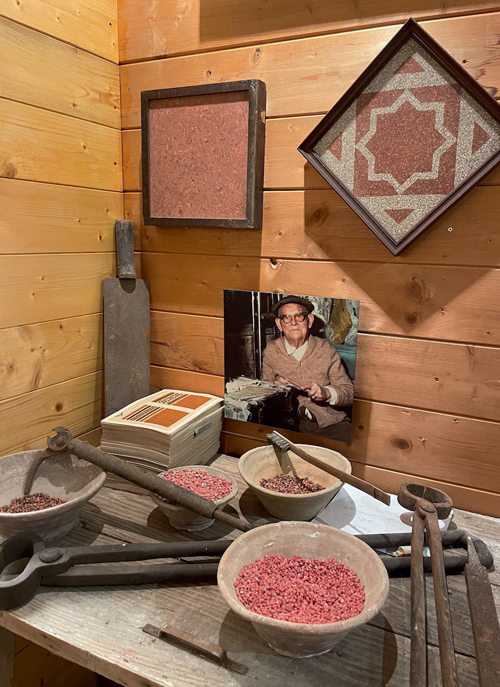
Coral Museum, Enzo Liverino Collection, Torre del Greco (Naples)
Professor Nestola introduced his new MADAM project that allows the study of nanometric fluid inclusions in these diamonds, potentially the very fluids that generated them, thanks to a new micro-diffractometer capable of structural (XRD) and chemical analysis of nanometric inclusions. Initial studies suggest a possible genesis of diamonds from carbonatites, a theory that will be further explored by the MADAM project.
Continuing the scientific thread, Professor Matteo Alvaro from Pavia University of Pavia discussed thermobarometric studies on diamond inclusions, which provide infor-mation on their formation depths, as well as elastic barometry, focusing on the distortion and mechanical behavior of inclusions within diamonds. Alvaro also introduced his desire to establish a first-level university master’s course in gemology, an initiative that, if realized, would be a wonderful asset for aspiring gemologists, offering specialized education that would be very important for navigating the complexities of our field. This program would not only elevate the professional standards but also create a new generation of highly skilled and knowledgeable experts.
The final session of the day focused on the charac-terization and science for a transparent market. Gioacchino Tempesta from Bari University presented his study based on the LIBS technique to analyze trace and light elements in gem-quality topaz, demonstrating the potential to distinguish geographic origins, despite its minimally invasive nature.
Marco Torelli from Masterstones followed, presenting the challenges in distinguishing natural from synthetic quartz, especially amethyst and citrine varieties, with an accessible tool for evaluating polarization response when standard spectroscopic or microscopic methods are inconclusive. He also touched upon the extensive industrial use of synthetic quartz, for example, in the watch industry, due to its piezoelectric properties. Nicola Precisvalle from IGI Antwerp delivered a highly engaging presentation on amber, particularly succinite (Baltic amber), expertly combining scientific insights with intriguing anecdotes about the gem. His study applied a multi-analytical spectroscopic approach to characterize succinite from Palmnicken, revealing new insights into its composition, thermal behavior, and geographic origin.
The first day concluded with Sara Monico, PhD student at Milan University, who presented her study on chrysocolla, a complex partially crystalline material, using advanced techniques, both chemical and structural, on samples from Italy and the USA, providing a result with new insights into its structure and composition.
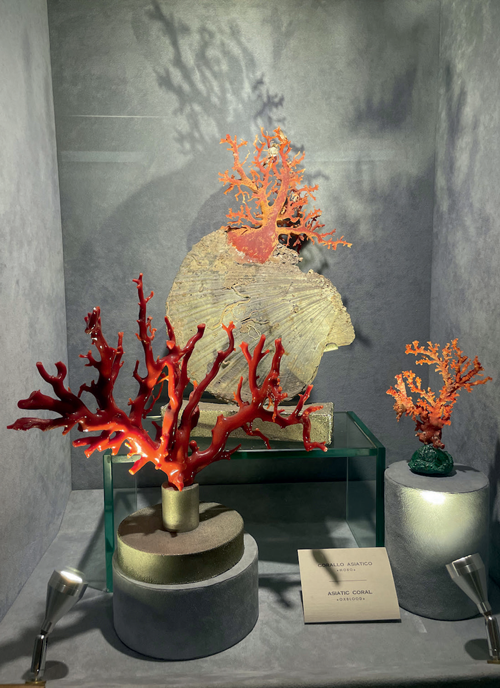
The day then transitioned into an unforgettable visit to the Coral Museum in Torre del Greco near Naples and the Liverino Collection. We had the incredible privilege of a private, guided tour led by Enzo Liverino himself. He passionately conveyed the artisanal tradition that has been a part of his family’s coral trade since his childhood. The museum houses samples of exceptional beauty and uniqueness, from magnificent branches of precious coral to exquisite coral cameos, sacred objects, and armour crafted from coral and hard stones, and even ornamental coral skulls. The intricate detail of the engraved objects was truly breathtaking. We also had the opportunity to see historical artisanal machinery for drilling and processing coral. It was a magical, wonderful, and deeply emotional experience, providing further opportunities for networking and relaxed conversation.
The evening continued next at the Coral Museum, where a dinner was held at Enzo Liverino’s country estate at the foot of Mount Vesuvius. This unique and enchanting occasion was both sophisticated and informal, imbued with a strong sense of Italian identity, complementing our earlier visit to the Coral Museum. Freshly baked pizzas from a wood-fired oven with local mozzarella created a relaxed atmosphere that promoted positive connections, exchange of ideas, and contacts. What struck me most was the evident sincerity of everyone present and their genuine interest in gemology. It underscored that this is a rare sector in which it is really important to have people driven by passion and a desire for understanding and transparency.
The second day began with a visually stunning presentation by Luciano Soprani from Taglieria Pietre Preziose, who spoke about the future of microphotography in gemology. He demonstrated its immense power for identifying synthetic gems and treatments, as well as for revealing crucial information about inclusions, textures, and color zoning.


He also showcased the winning photographs from the “Soul of Gemstones: From Earth to Light” com-petition, allowing us to admire the magnificent works of Muhammad Ayub, Giovanni Pace, and Francesco Protopapas. The same morning followed a session dedicated to the supply chain, from mining to laboratories, to cutting facilities, and then to the final piece of jewelry. The first speech was by Vincent Pardieu, field gemologist and consultant at VP Consulting, who emphasized the critical importance of gem traceability. He advocated for a reliable and documented collection of samples with verified origins, stressing the need to study trace elements to create an international database that allows gem laboratories to precisely indicate a specific geographical origin of gems.
The creation of this database relies on field gemology and the direct sampling of materials from precise, verified locations. Pardieu’s powerful message was that, while the jewelry world is increasingly prioritizing traceability and legal aspects, the genuine and sincere knowledge of a gem, its context, and its formation should remain paramount, preventing the industry from settling into a mediocrity where economic interest prevails. For a gemologist, the sincere pursuit of knowledge must be the driving force.
Following this thought-provoking talk, Rocco Gay from Petramundi underscored the importance of providing a gem pedigree to ensure transparency regarding origin, sustainability in mining, cutting, processing, and gemological data. In essence, he highlighted the need for transparency and knowledge throughout every step of the supply chain, from mine to finished jewelry.
Later, we heard Marco Calabrò, lawyer with a passion for gemology, who delivered a particularly insightful presentation on the power of certification. He explained the subtle yet crucial differences between a certificate and an attestation, advocating for transparency and correctness in the precious stone market. He related how minor differences in nomenclature can lead to significant problems and discussed common frauds and misconceptions in the gem world, such as those surrounding Bohemian rubies and the Black Prince’s Ruby in the British Crown Jewels.
Equally compelling was the journey shared by Marco Tironi of MT Mine Group (Mineração Turmalina Ltda). He explained how he became a producer by acquiring tourmaline mines in Brazil, highlighting the inherent difficulties in ensuring consistent production, economic viability, and control over sustainability, acquisition of titles, adherence to regulations, and the creation of dignified working conditions. He then showcased exquisite tourmaline specimens, among the results of his efforts.

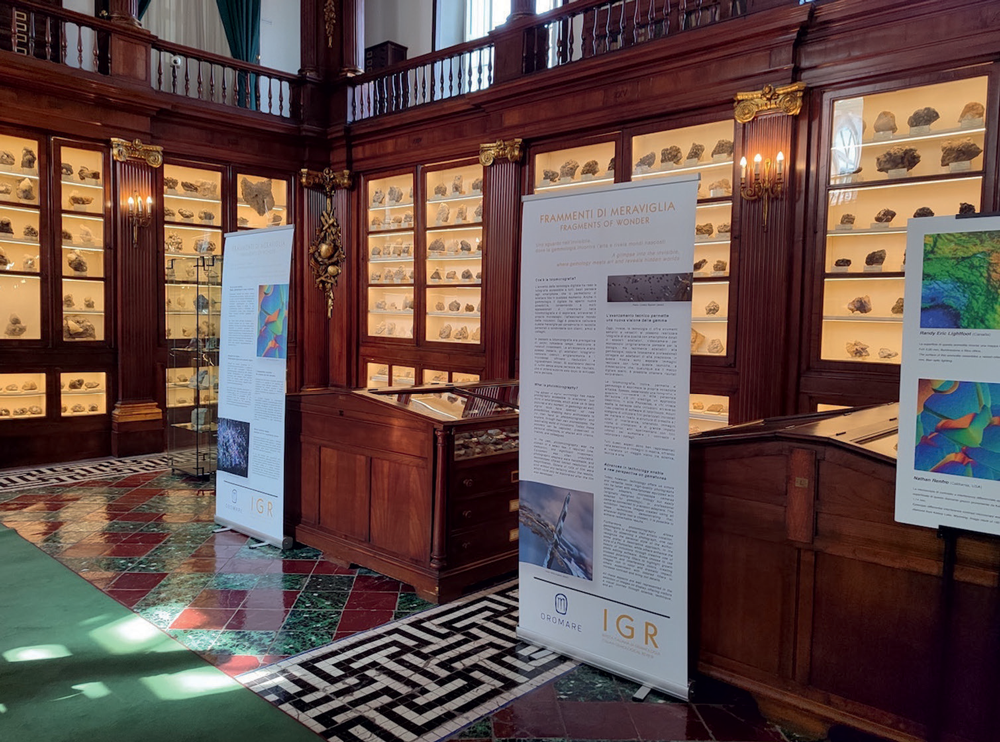
The morning continued with Stefania Coppola, from the University of Naples Federico II, presenting some recent studies that have redefined lapis lazuli as a polymineralic rock dominated not only by lazurite but also by sulfur-rich hauyne and other sodalite-group minerals, with true lazurite being extremely rare. This updated definition impacts gemological identification and valuation, emphasizing the need to consider the full mineral composition rather than a single mineral.
Domenico Romanelli from Gem Tech Gemological Institute presented his study that evaluated the stability of natural and synthetic rubies and sapphires, both treated and untreated, under typical phases of jewelry craftsmanship that can stress gemstones, such as heat, galvanic baths, ultrasonic cleaning, acid exposure, and physical damage. He showed how synthetic corundums generally show greater resistance, while treated stones, especially if impregnated or glass-filled, are more vulnerable. This emphasized the importance of treatment identification.
After this speech, Flavio Butini from the International Gemological Institute in Rome talked about how gem laboratories play a crucial role in detecting alterations which often reflect evolving treatment and synthesis techniques. His speech cited some recent examples, including treated, stabilized, coated stones, and imitations, highlighting the importance of accurate identification and terminology to protect customers.
Continuing the focus on gemological laboratories and their importance, Ludovica Faldi and Loredana Prosperi, from the Italian Gemological Institute in Milan (IGI), discussed the importance of gemological reports, which provide objective identification and characterization of gems using scientific terminology, emphasizing the need to distinguish between scientific data and analysts’ opinions to ensure transparency and trust in the communication of gem information.
The conference concluded with the presentation by Marilisa Yolanda Spironello, from Catania University, who discussed her interdisciplinary study, com-bining historical analysis and non-invasive Raman spectroscopy to identify and differentiate precious stones and imitations in Sicilian devotional jewelry from the 18th to 20th centuries. Her work highlighted how gemological diagnostics can reveal social, economic, and cultural aspects behind this production and use of sacred objects, aiding in their accurate attribution, conservation, and valuation.
The conference also offered the opportunity to attend a poster session, composed of three posters by young students. The first poster was Miriam Alberico’s study (University of Naples) about Ethiopian and Australian opals’ hydrophane behavior, using XRD and SEM-EDS, showing reversible changes that affect transparency, switching from opacity to transparence when exposed to water.
Another interesting poster was presented by Gabriele Alparone, from Catania University, dealing with the use of portable Raman spectroscopy to identify and catalog 59 colored gemstones from a private collection destined for the University of Catania’s Museum of Mineralogy, Petrography and Volcanology. With this technique, he managed to have an accurate identification supporting the authenticy and quality control of gems in both museum and commercial contexts.
The third topic featured Francesco Izzo’s (University of Naples) poster about non-destructive gemstone identification using external reflectance FTIR spectroscopy, highlighting the method’s properties and its value for heritage and gemological research. By analyzing 192 spectra, the study accentuated how ERFTIR can reveal key mineralogical properties, such as color, inclusions, anisotropy, and water content, offering a valuable tool for both heritage science and gemological research, especially for beginners. The work also discussed the method’s advantages and limitations, while providing guidance for proper spectral interpretation.
As I reflect on these two extraordinary days, the depth of knowledge shared, the innovative research presented, and the genuine passion radiating from every speaker and attendee left an indelible mark. For a young professional just starting out, this conference was more than an educational event: it was an affirmation of the richness and intellectual vitality of our field.
The opportunity to learn directly from leading experts, to engage in meaningful discussions with seasoned professionals, and to witness firsthand the cutting edge of gemological research are invaluable. The experience broadens perspectives, ignites new ideas, and builds a crucial network of contacts to support and inspire careers.
So, to every aspiring gemologist, to all recent graduates pondering their next step: seize every opportunity to attend conferences, workshops, and industry events. Step out of your comfort zone, engage with the speakers, ask questions, and connect with your colleagues. These gatherings are not just about acquiring knowledge, but they are about becoming part of a community driven by curiosity, dedication, and a shared love for the captivating world of gems. Your journey in gemology will be infinitely richer, more rewarding, and more impactful if you embrace these chances to learn, connect, and grow. This conference truly underscored that in gemology, knowledge is power and connection is key.

Francesca Gandolfo is an Italian gemologist working at Buccellati in Milan. She graduated cum laude with a Master’s Degree in Earth Science from the University of Milan in December 2023, specializing in mineralogy and crystallography. She then went on to obtain the gemologist certification at IGI (Istituto Gemmologico Italiano) in October 2024 and the title of FEEG European gemologist in July 2025.


