


The important colored gemstone, pearl, and diamond show, part of the Informa-organized Jewellery & Gem WORLD Hong Kong 2025, concluded its September edition, held September 15-19, at AsiaWorld-Expo (AWE). It attracted more than 50,000 buyers from 140+ countries and regions, who came to see the products of 3,000+ exhibitors, On the final day, September 19, I conducted in-depth face-to-face interviews with the ICA Pavilion participants, capturing unfiltered insights into sales dynamics, buyer sentiments, and market pulses.
Amid a notable resurgence in Chinese buyer attendance, the International Colored Gemstone Association (ICA) Pavilion emerged as a vibrant hub for colored gem specialists, hosting 33 exhibitors. This report weaves their collective experiences into a tapestry of resilience and recalibration, illuminating the pavilion’s role in a post-pandemic gem trade landscape.
Sales Performance: Steady Gains with Cautious Optimism

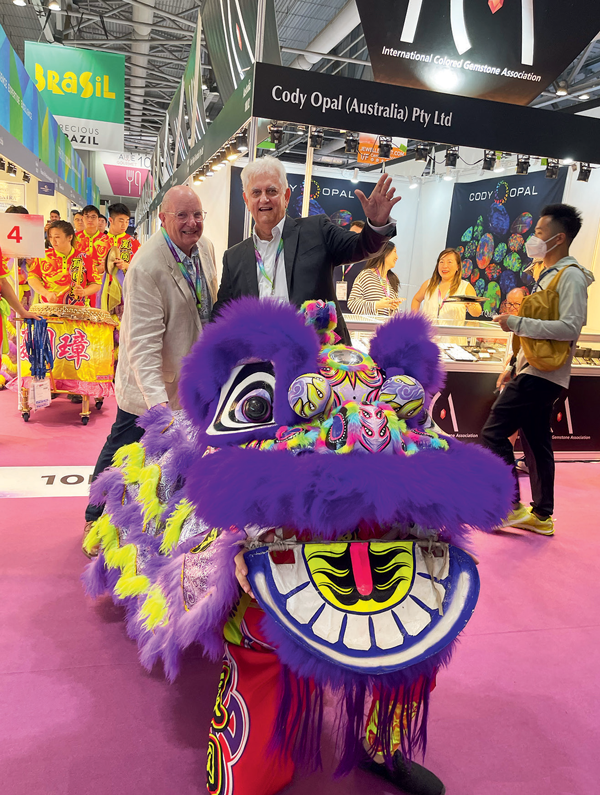
The ICA Pavilion’s ledger painted a picture of measured progress, with roughly two-thirds of the exhibitors reporting improvements over the March 2025 edition, although tempered by tight budgets and uneven traffic. Slow starts were commonplace, and many noted a sluggish opening, with momentum building on days 4 and 5, although the overall tone skewed positive compared to prior September shows.
Exhibitors who fared well highlighted a 10-30% uptick in sales, often exceeding expectations through a blend of repeat business and fresh inquiries. One described it as “much better than the last two years,” crediting Hong Kong’s tax-free allure for high-end niches. Another called it the “best show in 3-4 years,” securing 4-6 potential new clients amid calibrated emerald sales. High-end opal specialists saw “reasonably good” results, with sales outpacing March despite global headwinds. First-timers in the pavilion reported solid debuts, including 25% new clients for Mozambique rubies.
Stability marked the middle ground, with several achieving parity or slight gains, such as a 5% dip in Chinese sales that were offset by U.S. and Russian volume. However, challenges persisted: about one-third encountered declines of 20-30% from last September, citing a 95% drop in purchasing power and difficulty covering costs. “Challenging” was a recurring refrain, with some struggling to close deals amid diamond market slumps and generational disconnects. Follow-up business post-show emerged as a silver lining, with one noting “a lot happens after the event,” including Singaporean conversions. Comparisons to Bangkok loomed large ─ many viewed the September Hong Kong event as superior for high-end competition, although a few eyed the Thai fair for its holiday appeal and lower costs.
Buyer Demographics: A Broader, Budget-Conscious Mosaic

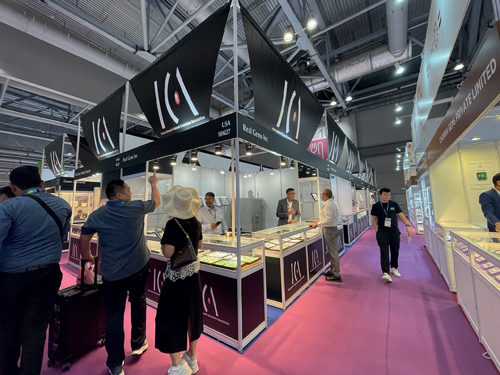
Buyer diversity enriched the pavilion, but caution defined the vibe. Chinese visitors rebounded strongly from March, comprising 80-85% for some, with higher budgets yet persistent tight-fistedness ─ exhibitors lamented Alipay transaction freezes over 50,000 RMB, even as intent remained high.
Japanese and European contingents grew, alongside Russian attendees (notably for high-end opals), as well as Indians, and Southeast Asians (Malaysia, Indonesia, Philippines, Viet-nam), though the latter often window-shopped without converting.
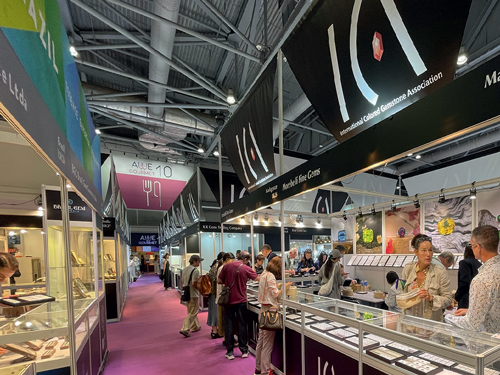
New client ratios varied, amounting to 20-40% for many, skewed toward Europeans and Russians, while others relied 60% on loyalists. U.S., Middle East, Iranian, Taiwanese, Thai, Australian, and Israeli faces dotted the aisles, but absences stung. There were fewer locals, no Taiwanese in one case, and scant Southeast Asian buyers.
Tight budgets dominated, with a 10-20% spend reduction, yet big-ticket Europeans and post-show follow-ups provided ballast. One exhibitor quipped about a “95% decrease in purchasing,” underscoring a global squeeze, while another celebrated exceeding expectations thanks to Vietnamese and South Korean windfalls.
Product Trends: Calibrated Classics Amid Niche Surges
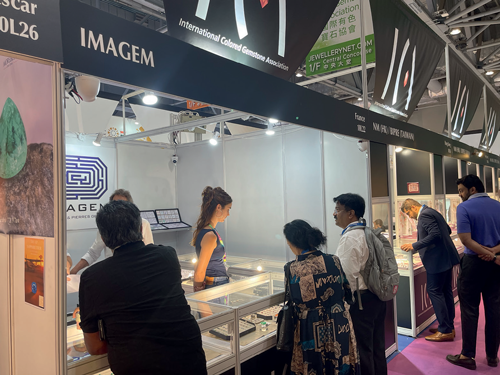
Demand crystallized around practical, calibrated gems, reflecting buyers’ thrift. Zambian and Colombian emeralds (1-5 cts, US$300-$3,000/ct, no oil) led, alongside Brazilian alexandrite (US$3,000-$6,000/ct), unheated Burmese ruby (US$6,000-$100,000/ct), as well as Mozambique Paraiba (big stones, steady pricing).
Following these were aquamarine, morganite, spessartine, tanzanite, spinel, and tourmaline (lagoon, pink/blue) with calibrated sizes (below 2-3 cts) and commercial grades (US$5,000-$6,000) dominating for jewelers and designers.
Opals bucked the mid-range slump, with prices edging up. The high-end (US$50,000+) and low-grade commercial (1-2 cts, US$3,000/ct) thrived, fueled by Russian growth and Malaysian/Philippine uptake. Ruby beads, Sri Lankan/Burmese sapphires (3-5 cts, US$100,000-$1M), and Cambodian zircon (10+ cts, US$200-$1,000/ct) saw niche interest, although no broad trends.
Prices held firm or rose slightly (e.g., opals steady-up), but sourcing hurdles ─ such as 50% cost hikes ─ squeezed margins. High-end jewelry traffic surged, with fashion houses scouting fine cuts and clarity (US$500-$100,000 range), signaling a premium pivot.
Exhibitor Feedback: Proximity, Promotion, and Post-Show Polish
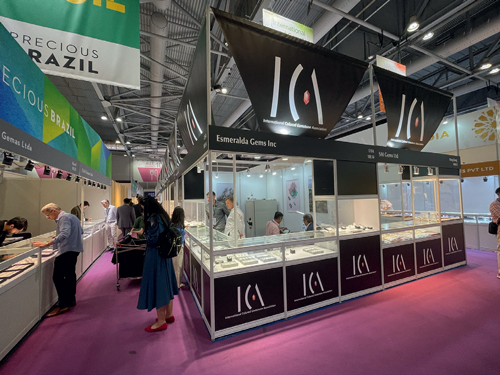
The ICA Pavilion earned kudos for efficiency and organization ─ better than March and last year ─ but critics honed in on logistics and support. Booth proximity irked some: “too close to Brazilians,” with pleas for face-to-face layouts over back-to-back. Promotion gaps loomed large ─ “ICA doesn’t do promotion” ─ prompting calls for enhanced exhibitor services, targeted marketing to pinpoint generational wants, and clearer market positioning amid confusion over addressed demographics.
Bangkok comparisons fueled debate: HK’s niche high-end edge versus Thailand’s convenience was discussed, although many dismissed the rival for lacking tax incentives. Positives abounded, however, such as smooth operations, networking with industry leaders, and Instagram live experiments yielding Japanese traction. Synthetics stayed sidelined, but post-show follow-ups underscored relationship-building’s primacy. Most exhibitors stated they plan to return next year, with a handful wanting to try the March and/or Bangkok shows.
Conclusions
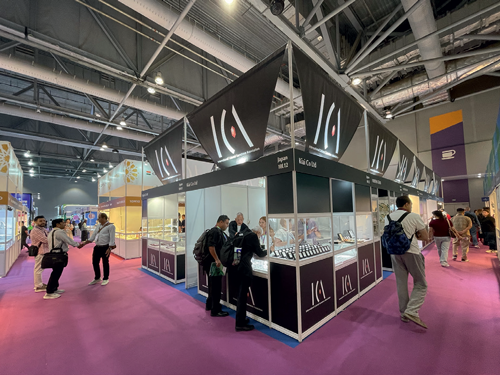
September’s ICA Pavilion pulsed with guarded hope, outshining March’s gloom through diverse buyers and calibrated demand, even as budgets pinched and new faces proved elusive. The Chinese resurgence and high-end resilience hint at stabilization in a $121 billion market trajectory, yet exhibitors crave sharper edges to cut through competition.
Images are courtesy of the author.


