We live in an extraordinary time—an era of creating a new form of art: the art of faceting. Before diving into this, let me clarify what I mean by “art.” In my view, high precision and exceptional craftsmanship alone are not enough to define something as art. The use of innovative techniques or revealing the beauty and potential of a gemstone isn’t sufficient either. True art must evoke emotions and associations in our minds. Sometimes, the object itself speaks for its idea clearly. However, it is often helpful to give it a name, directing our minds to the concept and guiding our understanding.
Take, for example, a sculptor who creates a lifelike dog from stone, where each hair is visible in great detail. But is this art? We see the dog, but that’s all. Where is the idea? Where is the artist’s message? For me, this is craftsmanship—admittedly, with a high level of skill—but not art.
If, however, we added something more—say, eyes full of suffering—then the entire composition would express loneliness and stir emotions of compassion. Now, that would be art.
For centuries, gem cutting was seen solely as a craft, aimed at enhancing the beauty and value of gemstones. No one considered that a faceted gem could be a tool for expressing an artist’s inspiration, just as marble serves the sculptor, paint the artist, and sound the musician.
Of course, stones have been used in carving and mosaics for centuries, but faceted gems have never been considered as a medium for artistic expression. This is the art of the future. And as I delve into this emerging art, I’d like to share with you a glimpse from my own collection, World Heritage Gemstones.
There are many countries, cultures, and histories, each with its own rich and diverse heritage. Five years ago, a thought struck me, and I was overcome with excitement: Multi-Faceted! Until then, no one had thought to facet elements of cultural heritage in the literal sense. With the experience gained from three previous collections—Philosophical Stone, Sacred Symbols, and Elements, which incorporated images in the patterns of facets—I realized that such a concept was possible, though challenging.
Initially, my goal was simple: to showcase images linked to specific cultures or countries. But then I realized that this idea wasn’t new or particularly captivating, because symbols like crosses or stars had already been used in faceting.
If this collection were to carry a significant name, its content needed to be significant as well. Hence, a new idea emerged: to create complete compositions that draw from the symbols and images of particular cultures, reflecting their ideas. Not just any idea, but a deep grain of wisdom or layered concept that invites contemplation.
At present, this collection includes twelve cultures, each represented by a stone and a concept crystallized in its name. Alongside contemporary cultures, I have included stones representing vanished civilizations, such as Ancient Egypt and the Roman Empire.
Each stone carries not only a name but also a brief description that helps focus the idea behind its design.
Faces of Perfection
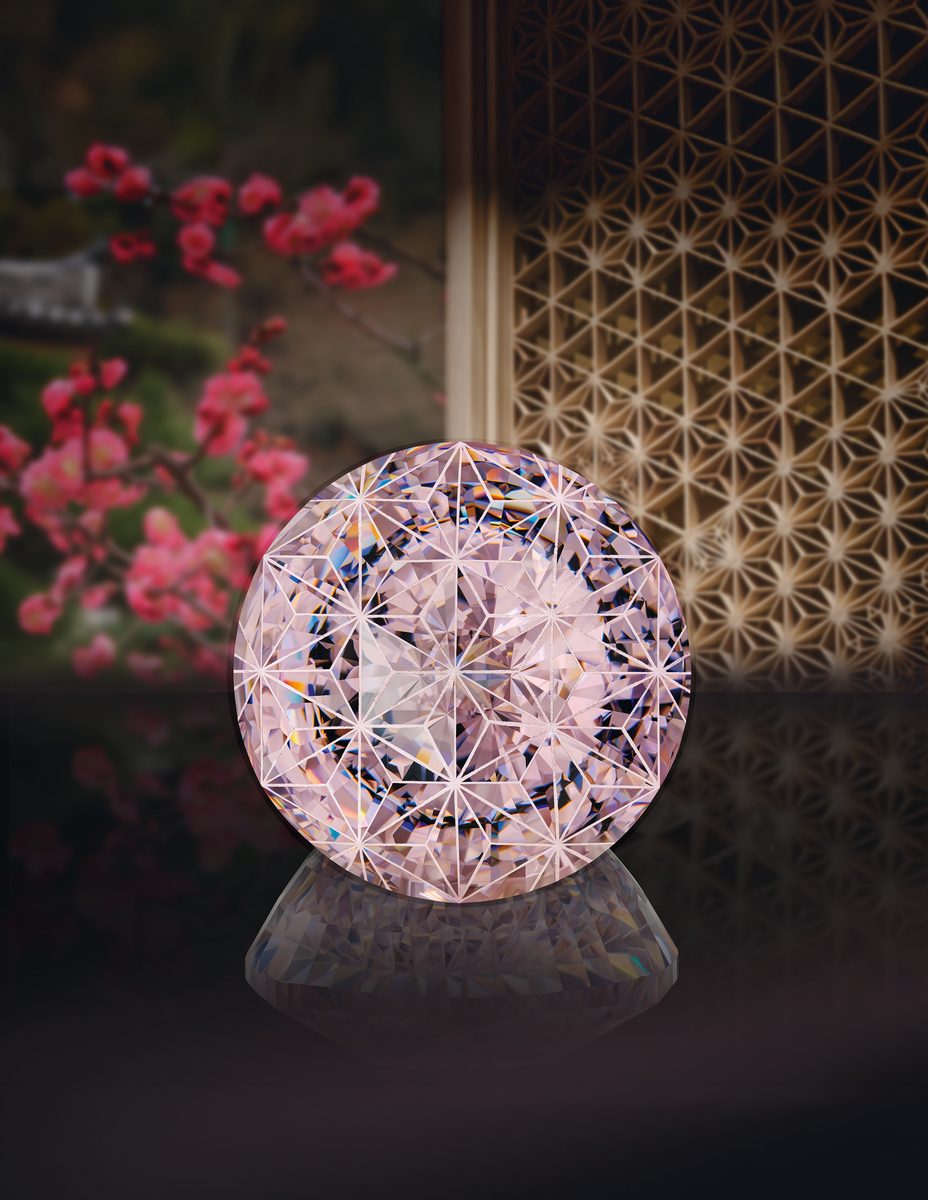
The first example I would like to share is Faces of Perfection, dedicated to Japan. I had the privilege of visiting Japan twice, separated by 20 years—first in 1985 and then again in 2005. Both times, I was profoundly struck by the preservation of traditions—the reverence for Nature, the strength of the ancient samurai, and the appreciation for fleeting beauty.
It became clear to me that the Asanoha, an ancient Japanese design, symbolizing the balance of Beauty and Strength, could form the foundation of the stone’s composition. Additionally, I wanted to capture a fleeting moment: the Sakura flower trembling in the rays of the rising sun. Thus, the flower emerged from the stone, surrounded by rays radiating from the center to the girdle, meeting reflections of the fallen petals in three wavy circles leading to the girdle.
The text accompanying this piece reflects the traditions of Japan and the interplay between the fleeting and the eternal: The Sakura blooms quickly, and the sword’s swing is imperceptible. Yet the beauty of the flower is eternal, just like the power of the ancient sword. Strength and Beauty are two faces of the same Perfection…
Fragility of the Eternal
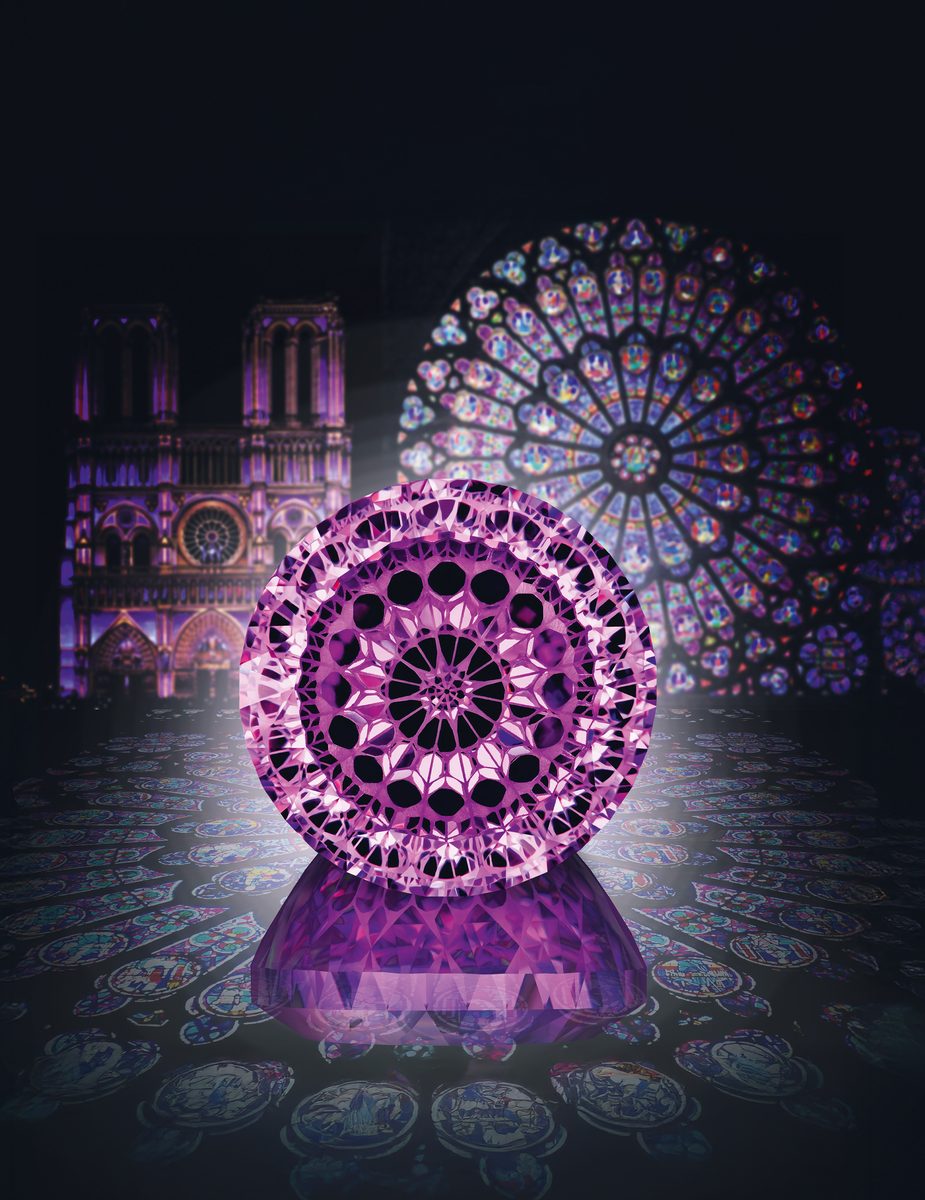
Dedicated to France, Fragility of the Eternal reflects the delicate balance of cultural preservation. Inspired by the 2019 fire at the Notre Dame Cathedral, it reminds us how easily history can be destroyed. History teaches us how fragile our heritage is. What has been built and preserved for centuries can be lost in a matter of hours.
The stone features a disproportionately large table facet, representing a window through which the remaining stained glass rose of the cathedral can be seen. This window is reproduced with great care and is formed by 977 pavilion facets.
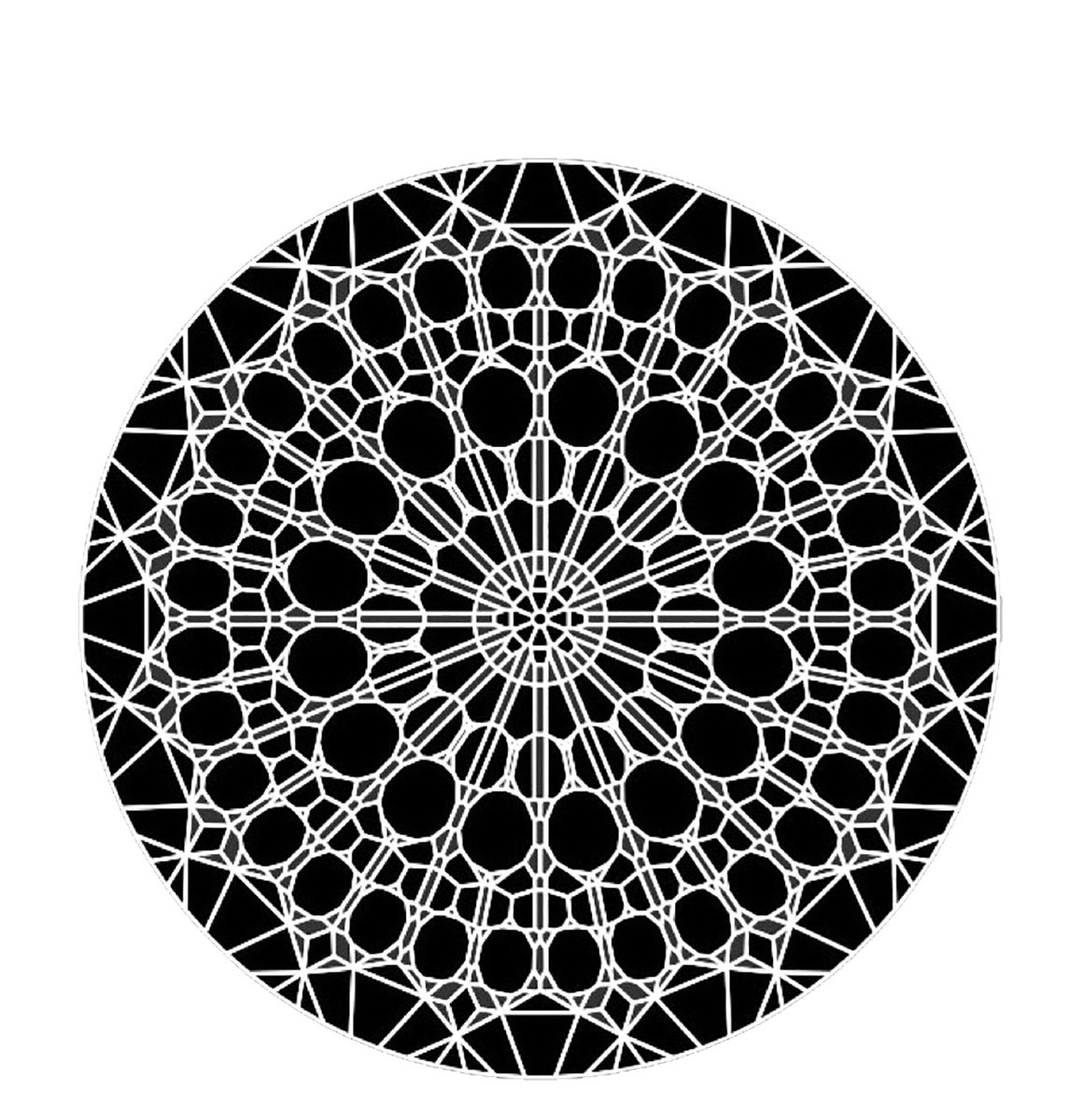
Let me emphasize that this unique technique has not yet been found in the work of other masters. I’m not talking about frosted edges between polished facets so that they emphasize the pattern in contrast. Rather, the meeting points of these edges are decorated with the smallest matte triangles, creating the impression of smoothed, rounded corners.
The number of facets in Fragility of the Eternal is 1,250. I might add that creating over 1000 facets has ceased to be something extraordinary but rather is now the norm for the World Heritage series.
Arabian Night
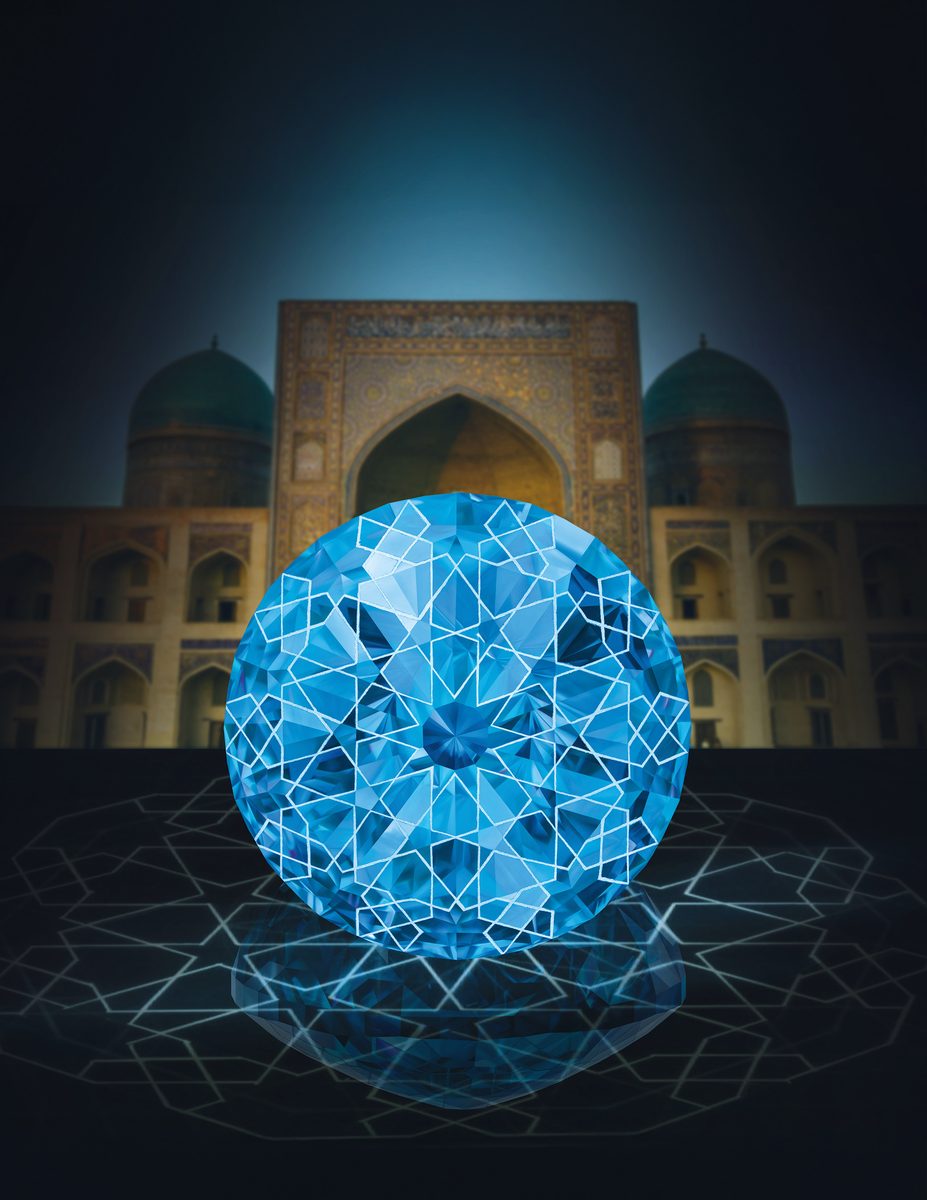
Moving to the Arab East, Arabian Night is one of a small set of four stones dedicated to ancient cultures (Persia, Egypt, Greece, and the Roman Empire). Inspired by the tales of the immortal 1001 Nights, the stone’s 1001 facets form a technically complex star-shaped design of the crown and an intricate whimsical stepped pattern in the pavilion. How many fairy tales are hidden in the Arabian night? What grains of wisdom are twinkling in its depths?
The Arabian Night stone is also remarkable in that it can be viewed not only from above but also from the side. The stone’s design invites reflection on the wisdom hidden in the tales of the Arabian nights, and, from the side, one can see the majestic dome of the Mir-Arab Madrasah in Bukhara, Uzbekistan.
Versatility of Genius
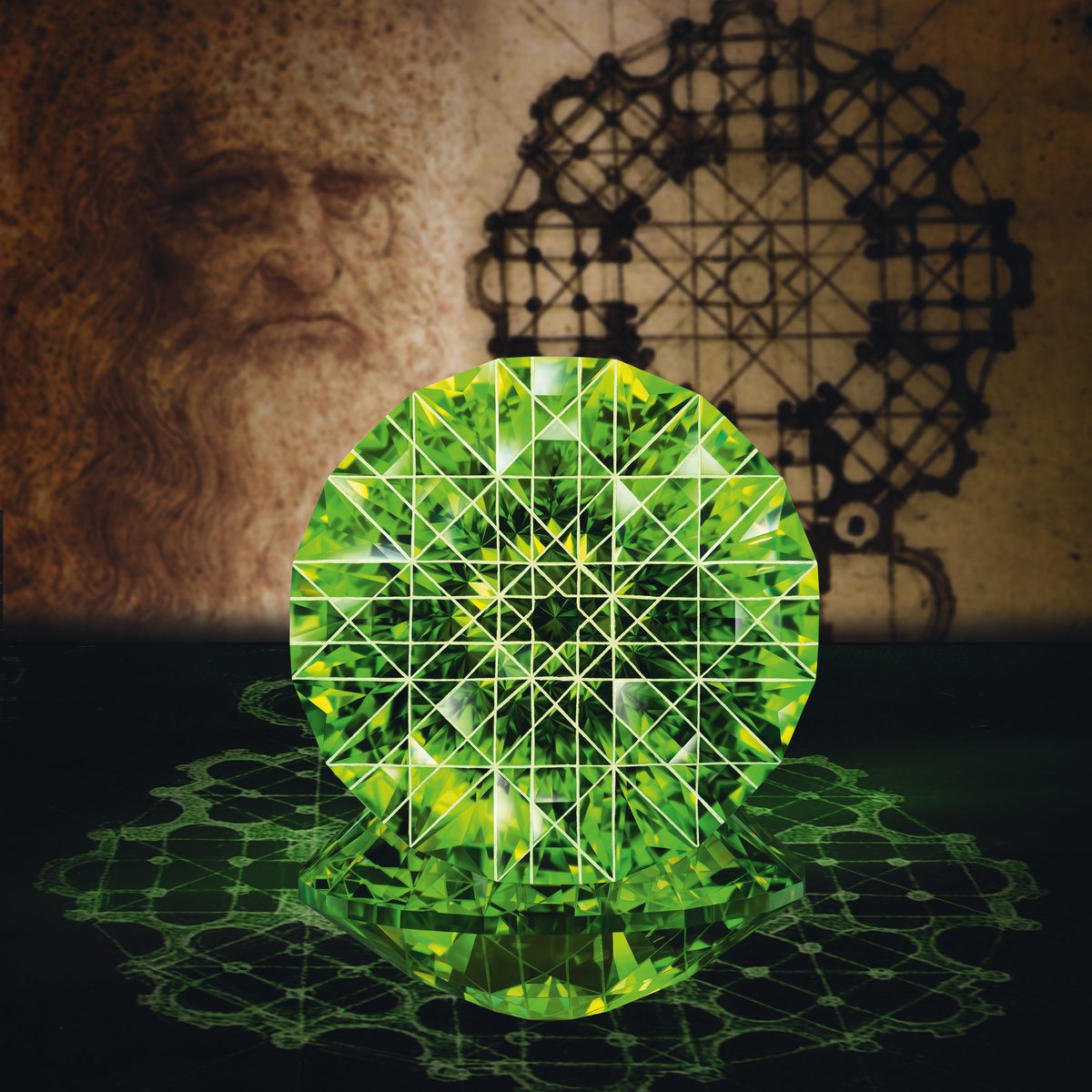
Versatility of Genius was created based on a design by Filippo Brunelleschi—an architect, engineer, mechanic, mathematician, artist, and jeweler, whom Leonardo da Vinci regarded as his mentor. One of Brunelleschi’s notable works includes the drawing of the rotunda of Santa Maria degli Angeli in his hometown of Florence, a masterpiece admired for its precision and harmony.
This drawing served as the foundation for the stone’s crown design. On the pavilion, three stars are inscribed within one another, symbolizing the seamless integration of craft, science, and art—three fields that flourish in the work of “universal minds.” When the beauty of artistic imagery and the precision of geometric structures come together in perfect harmony, they embody the versatility of genius.
Heart and Essence
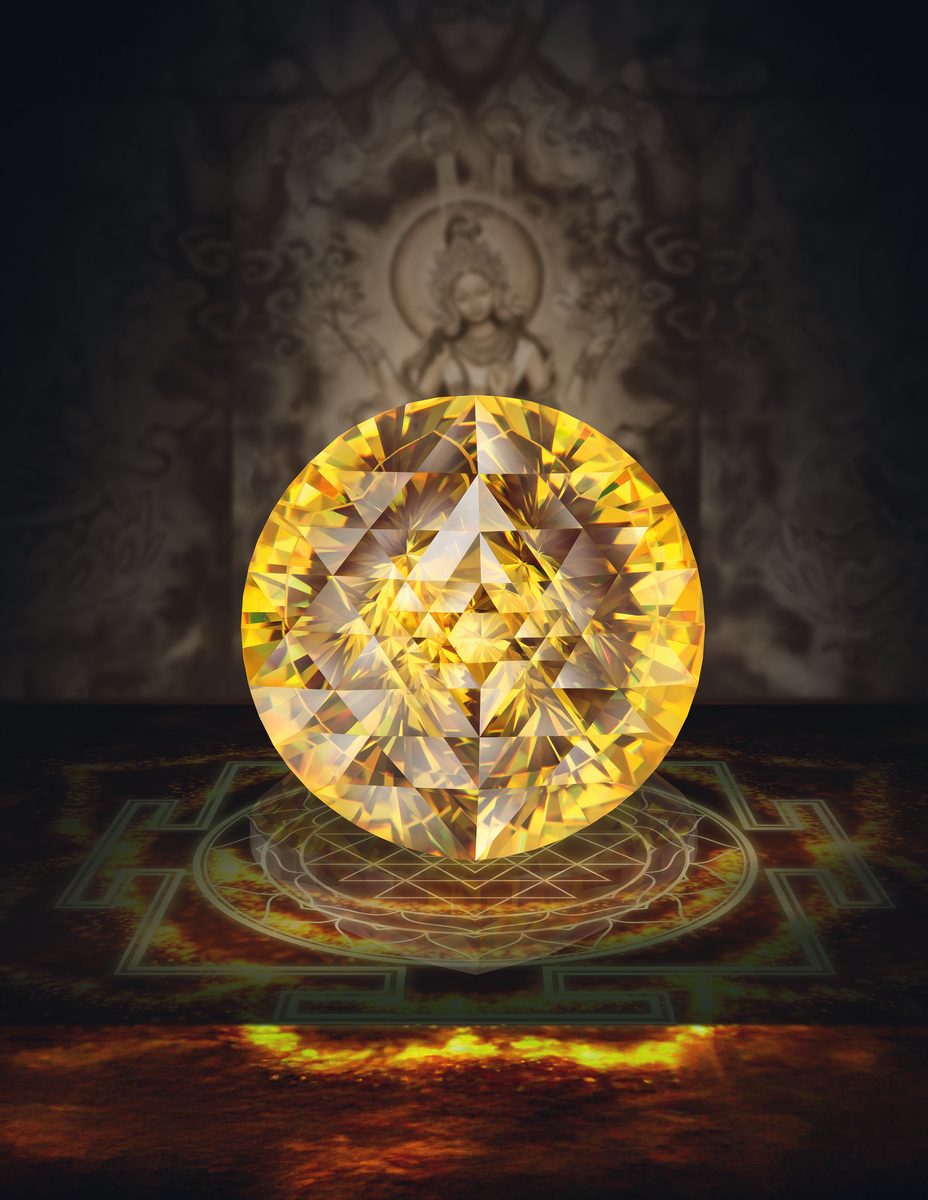
Dedicated to India, Heart and Essence reflects religious traditions. Here, beauty is understood not just as a superficial quality, but as a powerful, protective force, symbolized by the Hindu gods Vishnu and Lakshmi. Beauty is both the end and the means; the Ray of the middle path—the Ray of Preservation—shines like a treasure in a lotus flower between the forces of Creation and Destruction, like the spirit of a trilingual Flame, being the heart and essence of our Universe… Symbolically, the power of Beauty as the essence of the Middle Way is precisely expressed by the lotus flower.
It is no coincidence that Goddess Lakshmi holds a lotus in the various representations. With its three petals and twelve-pointed star (symbolizing the trilingual flame), the lotus is prominently featured on the stone’s pavilion, symbolizing the power of Beauty as the essence of the Middle Way.
“Oh, the treasure in the lotus flower!” says the great mantra in literal translation. And, as if deciphering this deepest symbol, the Sri Yantra, the image of our universe, is depicted on the crown of the stone.
Ariadne’s Thread
As we continue our journey into the past, Ariadne’s Thread is dedicated to ancient Greece. Since the time of the ancient mysteries, we have been commanded to listen to the voice of the heart, which, like a guiding thread, will help to get out of the mess of fuss and problems.
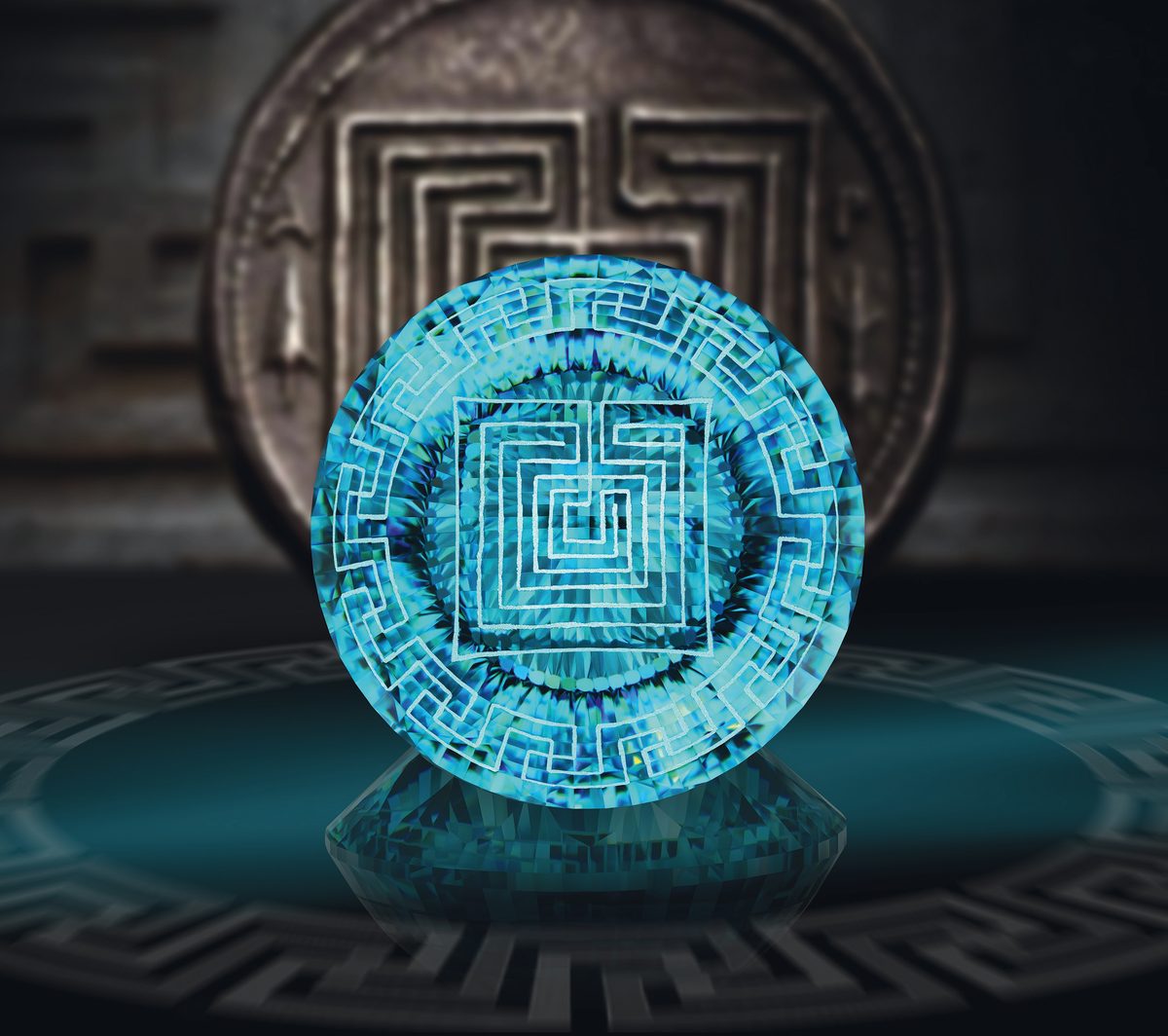
On a vast field of 225 squares, like a chessboard, covering the crown, is a labyrinth pattern, accurately reproduced from a genuine Cretan coin. Symbolizing the voice of the heart that guides us through life’s chaos, the labyrinth is surrounded by a meander pattern that flows like an ancient Greek melody.
Both the labyrinth and the meander are made with thin frosted facets, some of which contain 15 separate pieces in one straight line. On the pavilion, a 12-rayed star, inscribed in a flower with wide petals, symbolizes the wealth and prosperity of the Greek civilization.
Giving Life
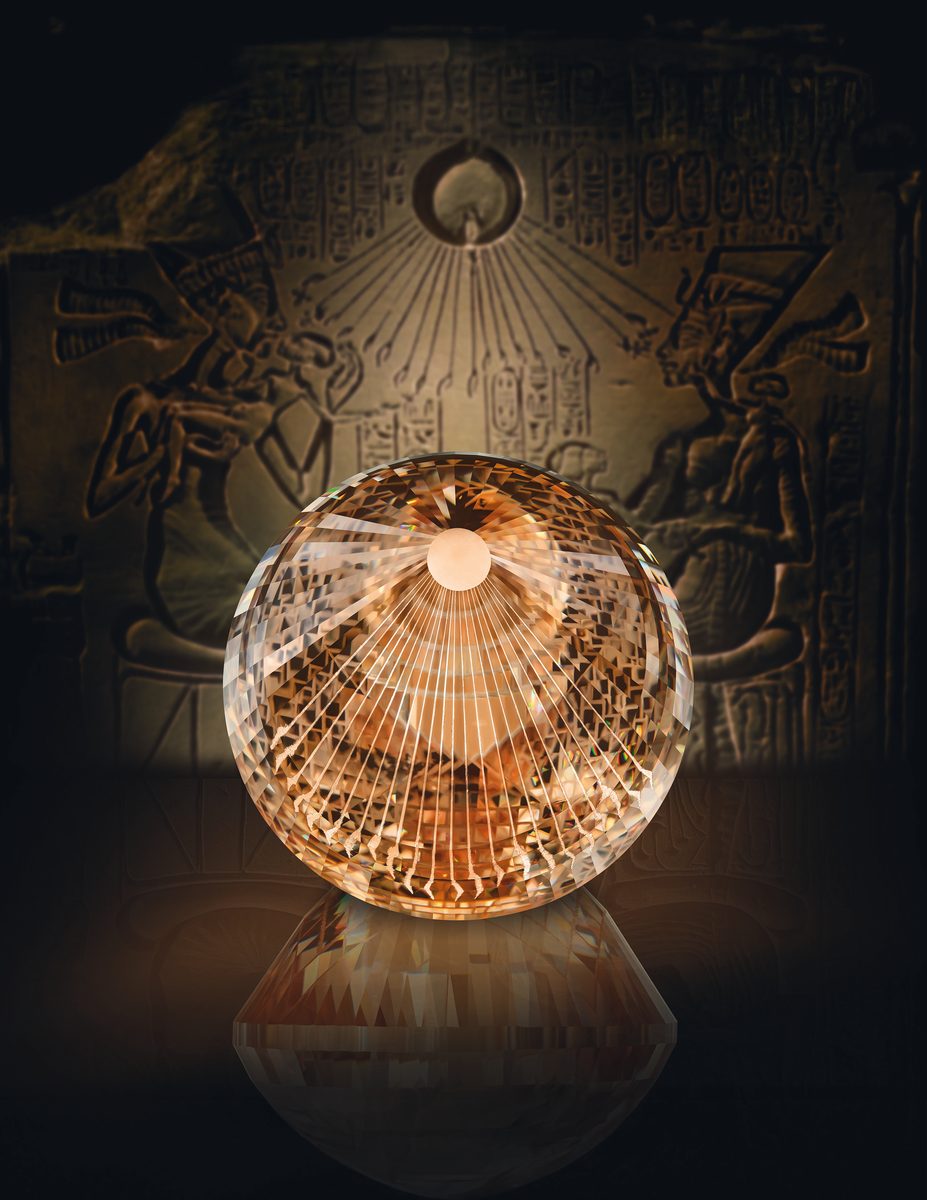
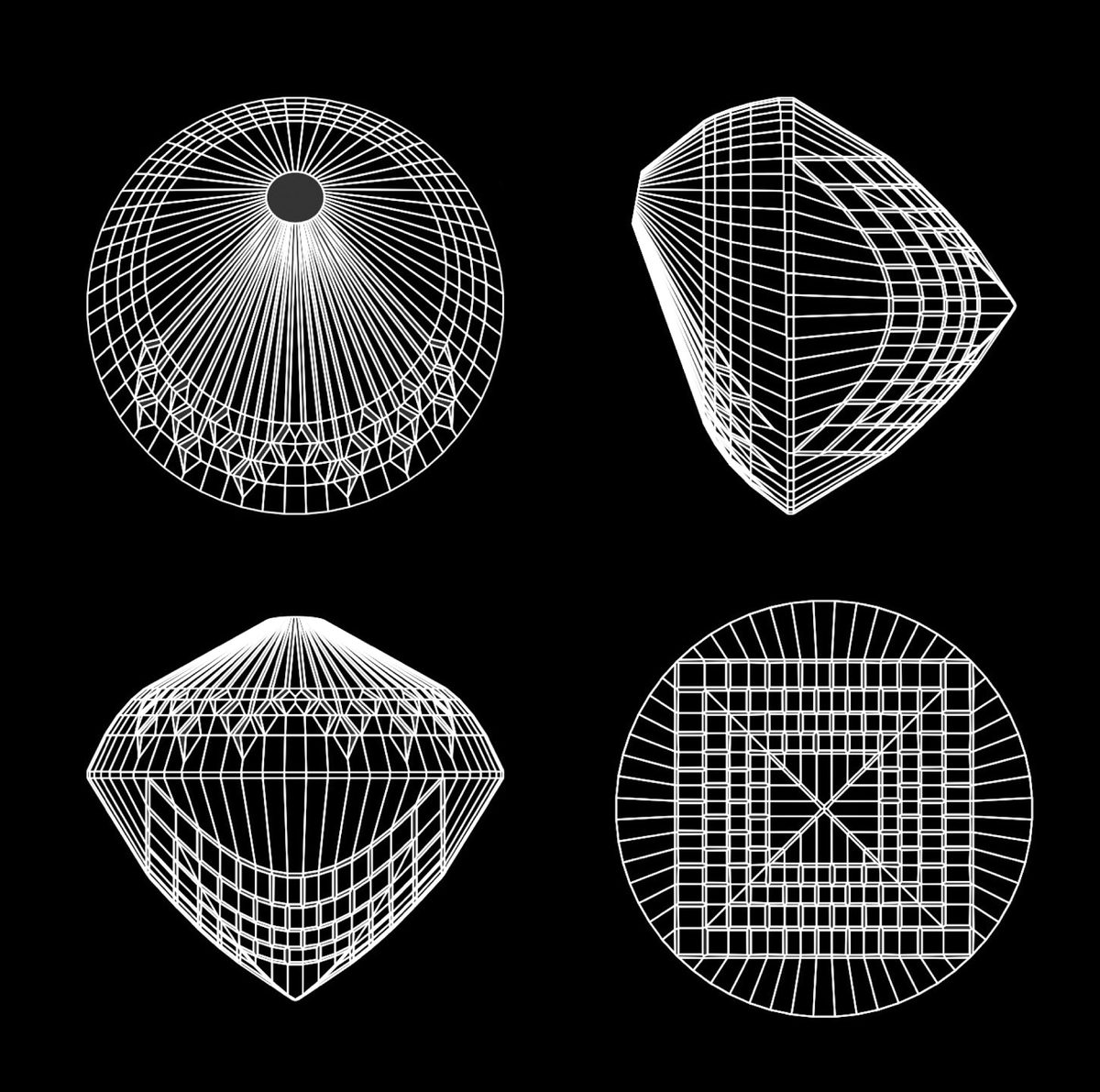
The final stone I mention here is Giving Life. Inspired by Ancient Egypt, it draws from the stela of Akhenaten, showing the Pharaoh with his wife and children, under the rays of the Sun. These rays, ending in hands, give life to the family. The stone’s design mirrors this, with rays emanating from a small central facet at the top, and a pyramid formed by rectangular facets on the pavilion, symbolizing the eternal nature of existence.
Conclusion
To sum it up, I believe that every stone in the World Heritage collection is, in the truest sense, a work of art. The art of faceting, now in its infancy, will surely continue to evolve, finding its rightful place among painting, literature, music, and other revered forms of expression.
About the Author
Born in Siberia in 1964, Victor Tuzlukov then grew up in Russia. The range of his interests is very diverse. He enjoys travelling, photography, sports, and literature. His philosophical tales were awarded at the international literary contest “The Golden Feather of Russia.” Victor graduated from the Moscow branch of the GIA with the diploma of Graduate Gemologist.
In 1999, he found what would be his life’s work and passion. He began learning about faceting gemstones. Soon, he was participating in many technical faceting competitions. He is Grandmaster of the U.S. Faceters Guild and winner of many international awards, including the “Extraordinary 40” of the Jewelry World. He is featured in the Guinness Book of World Records and his gems are in many of the world’s most prestigious museums, among them the Smithsonian Institution in Washington DC and the Los Angeles Natural History Museum.
Currently, Victor lives and works in Thailand, where he teaches precision cuts and collaborates with jewelry companies and gemological institutes in gem design and the grading of cut quality.
Photos are by Andrey Kalinin.